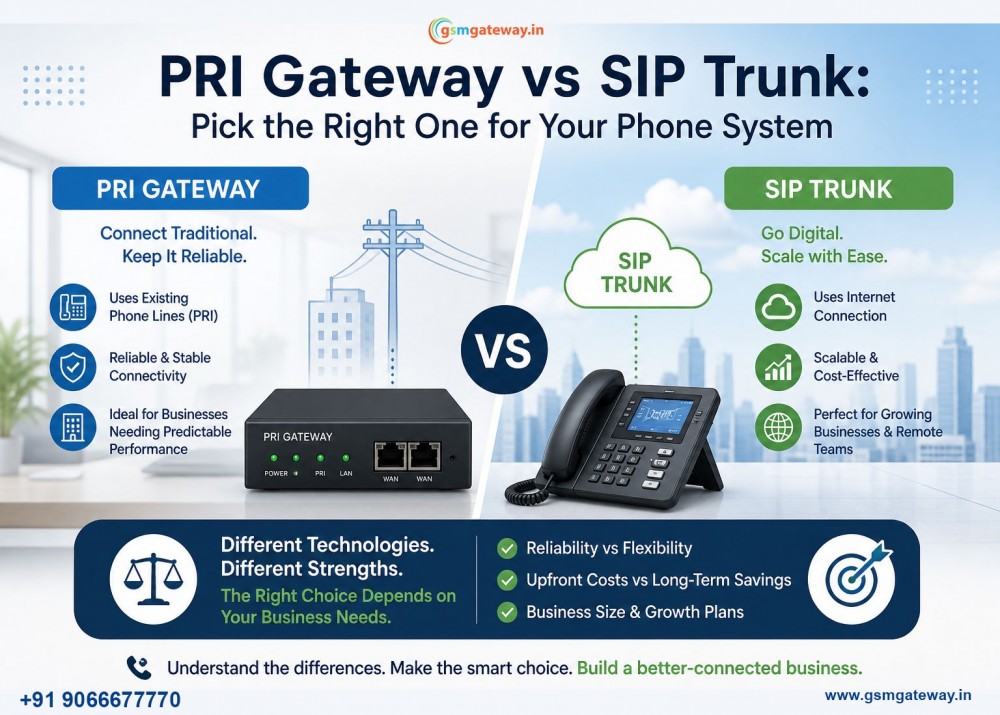
Choosing between a PRI gateway and a SIP trunk can define your business communication quality, cost, and scalability for years. This guide breaks down both options so you can make the right call — without the technical jargon overload.
What Is a PRI Gateway?
A PRI (Primary Rate Interface) gateway is a hardware device that connects your traditional ISDN PRI telephony lines to a modern IP-based PBX or unified communications system. Think of it as a bridge between the old PSTN world and your new digital infrastructure.
In India and globally, many enterprises still operate on legacy PRI circuits leased from telecom providers. A PRI gateway allows these businesses to retain those circuits while migrating their internal phone system to VoIP — avoiding the cost of a full infrastructure overhaul.

At Gsmgateway.in, we supply and support a wide range of PRI gateway devices — from compact 1-span units for SMBs to multi-span enterprise solutions handling hundreds of simultaneous calls.
How does a PRI gateway work?
A PRI line carries up to 30 voice channels (E1 in India/Europe) or 23 channels (T1 in North America). The PRI gateway converts these time-division multiplexing (TDM) signals into SIP or H.323 packets, making them readable by your IP PBX (such as Asterisk, FreePBX, or 3CX).
What Is a SIP Trunk?
A SIP (Session Initiation Protocol) trunk is a virtual phone line delivered entirely over the internet. Instead of physical copper or fiber circuits, SIP trunks use your existing broadband or MPLS connection to carry voice traffic.
SIP trunking is provided by an ITSPs (Internet Telephony Service Provider) and connects directly to your IP PBX — with zero hardware required at your end beyond a stable internet connection.

PRI Gateway vs SIP Trunk: Head-to-Head Comparison
PRI Gateway
Uses physical ISDN E1/T1 circuits
Hardware device on-premises
Highly reliable; no internet dependency
Fixed channel capacity (30 per E1)
Ideal for legacy PBX migration
Best for high call volume enterprises
SIP Trunk
Delivered over broadband/MPLS
No dedicated hardware needed
Dependent on internet quality
Elastic — scale up/down instantly
Ideal for cloud-first businesses
Best for startups and remote teams
Cost Analysis: Which Is Cheaper Long-Term?
The true cost comparison depends on your call volumes and existing infrastructure.
PRI gateways involve a one-time hardware investment (typically ₹15,000–₹80,000 depending on capacity) plus monthly PRI circuit rental from your telecom provider. For large enterprises making thousands of calls daily, the per-minute cost is often lower than SIP trunking at scale.
SIP trunks have no hardware capex. Providers charge per concurrent channel or per minute of usage. For businesses with fluctuating call volumes, SIP trunks are considerably more cost-efficient — you pay only for what you use.
Can You Use Both Together?
Absolutely — and many enterprises do. A hybrid telephony setup uses PRI gateways for core, high-volume PSTN calling while SIP trunks handle overflow, international calls, or remote office extensions. This gives you the rock-solid reliability of PSTN with the flexibility and cost savings of VoIP.
Gsmgateway.in specializes in designing and supplying hybrid telephony infrastructure. Our team helps you map out the right combination based on your call data, geography, and budget.
PRI Gateway: Key Technical Specs to Check
When buying a PRI gateway, evaluate these specifications to ensure compatibility and performance:
Number of E1/T1 spans — each E1 span supports 30 simultaneous voice channels. Choose 1-span for small offices, 2–4 span for mid-size call centers, and 8+ span for large enterprises. Supported protocols — ensure SIP, H.323, and ISDN PRI compatibility. Codec support — G.711, G.729, G.722 are the most important. Echo cancellation — critical for call quality over long-distance PRI circuits. Failover features — look for built-in redundancy and failover routing options.
Frequently Asked Questions
Q: What is the main difference between a PRI gateway and a VoIP gateway?
A PRI gateway specifically interfaces with ISDN PRI/E1/T1 lines and converts them to SIP/IP. A VoIP gateway is a broader term that can include FXO/FXS analog gateways and GSM gateways as well. All PRI gateways are VoIP gateways, but not all VoIP gateways are PRI gateways.
Q: Can a PRI gateway work without a PBX?
Most PRI gateways are designed to work alongside an IP PBX or call manager. However, some advanced models include basic call routing built-in. For full call management features, pairing with an Asterisk or FreePBX server is recommended.
Q: Is SIP trunking cheaper than PRI in India?
For most small and medium businesses, yes — SIP trunking from Indian providers is significantly more affordable than leasing PRI circuits from BSNL or private operators, especially if your call volumes are variable. For high-volume call centers, PRI circuits may still be more economical per minute.
Related Service:
Call Center Dialer | Auto Dialer Software | IVR System | Volte Gateway