

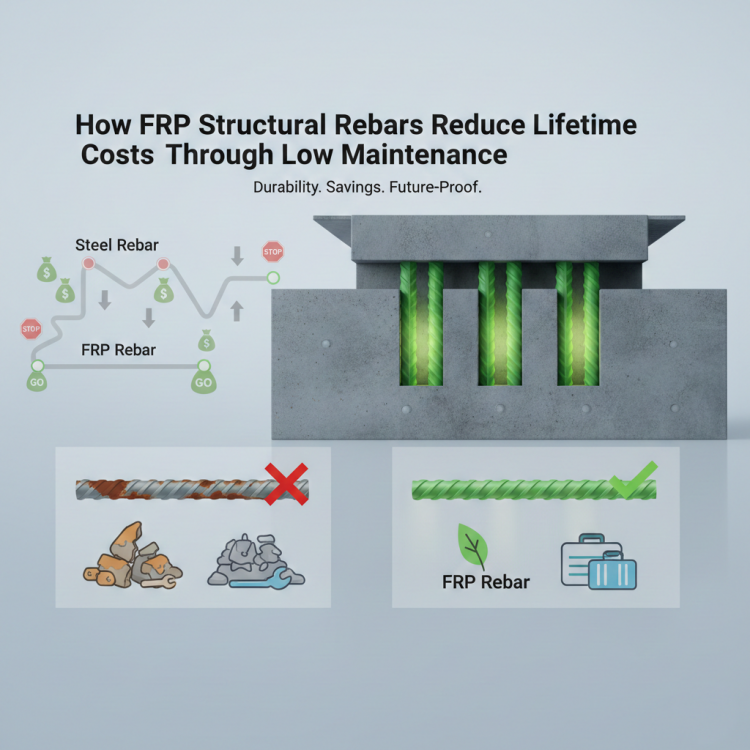
There’s a silent revolution taking place in the construction industry—one that most project owners notice only when maintenance bills start piling up after 8–10 years of service life. If you are someone who has closely observed how modern infrastructure ages, then you must have seen that corrosion has been the killer-factor of reinforced concrete. It eats up budgets, weakens structures, and forces expensive repairs.

And this is exactly where FRP rebar has been a material that isn’t just a construction “alternative”, it’s strategic innovation material. When you look at how contractors, developers, and asset owners calculate long-term savings today, the usual pattern is reducing frequent maintenance to minimize lifetime cost.
In this article, you will know why FRP structural rebars are rapidly becoming the backbone of future-ready construction, and why, in the next 50 years, this material deserves serious attention.
When Do Maintenance Costs Determine If a Structure Becomes an Asset or a Liability?
Concrete has a naturally long lifespan, but the steel inside it often doesn’t. The moment steel is embedded in concrete, it starts reacting with the environment. Moisture, chlorides, industrial chemicals, groundwater salts, and even daily temperature cycles start affecting it from day one. Over the years, this exposure triggers corrosion, which then causes expansion within the concrete. This expansion leads to cracks, surface spalling, reduced load-bearing capacity, and eventual structural deterioration.

In high-exposure environments such as bridges, coastal structures, water-retaining facilities, basements, and highways—these issues accelerate even faster. In fact, industry studies consistently show that maintenance and repair costs over a structure’s life can exceed the initial construction cost, sometimes by a wide margin. This is where the financial equation changes. You will realise that:
- Choosing cheaper reinforcement increases long-term expenses.
- Choosing durable materials reduces operational and maintenance overhead.
So now, the question is, “Is it possible to build reinforced concrete that eliminates corrosion and lowers lifetime cost?”
This is exactly where FRP reinforcement changes the economics. It transforms how structures age and how much they cost you over decades of use.
How FRP Rebars Lower Lifetime Maintenance Costs
When you are building a concrete infrastructure, you expect it to stand strong for a long-term. When you run behind saving a little during construction, this often leads to higher maintenance costs later. But choosing FRP rebars is an assurance that you are using reinforcement that stays strong for decades with minimal repair work.
1. No Corrosion Means No Repair Bills
Corrosion is the biggest weakness of steel-reinforced structures. When steel rusts, it expands and cracks the concrete, leading to expensive repairs year-after-year.
But, FRP rebar does not corrode at all. This means:
- No cracking from rust
- No delamination
- No repair cycles
2. Longer Life Means Lower Cost per Year
Steel structures usually need major rehabilitation within 20–40 years.FRP-reinforced structures are different in that way. They often last 75–100+ years with minimal upkeep. When you calculate the cost per year, FRP becomes far cheaper in the long run. It is also proven that FRP can reduce your construction lifecycle costs by 30–50% due to its extended service life.
3. Less Concrete Cover Saves Materials and Money
Steel rebars need a thick layer of epoxy coatings, galvanizing, and cathodic protection which keeps them safe from rusting. FRP does not! Since FRP rebars are naturally corrosion-proof, engineers can confidently use them without compromising durability. This simple change leads to several practical benefits like:
- Thinner and more efficient structural elements
- Lower concrete usage across the project
- Reduced labour requirements
- Faster construction timelines due to easier placement
4. Excellent Performance Under Harsh Environments
Steel reinforcement is highly vulnerable in environments exposed to chlorides, sulphates, industrial chemicals, and constant moisture. These conditions accelerate corrosion and increase maintenance demands. FRP rebar, however, is chemically inert which means it does not react with salts, acids, or aggressive compounds commonly found in such environments.
As FRP rebars do not corrode or deteriorate under chemical attack, it eliminates the need for:
- Costly anti-corrosion coatings
- Frequent structural inspections
- Protective surface treatments
- Emergency repairs due to unexpected corrosion damage
5. Better Crack Control Over Time
FRP rebars respond differently to loads as compared to steel, and this difference plays a big role in how cracks form and behave over time. When FRP is properly placed into a structure, its elastic properties help limit the crack width and reduce the stress concentrations that typically lead to fatigue.
When cracks remain narrow and manageable, the entire structure experiences:
- Less Moisture
- Minimum Thaw Deterioration
- Reduced Surface-wear and Spalling
6. Lightweight Rebars Lead to Fewer Construction Errors
One of the practical advantages of FRP rebar is its weight. It's roughly 4–5 times lighter than steel. This difference may seem simple, but it has a major impact on how accurately the reinforcement is installed on-site.
Just because FRP is lighter, workers can handle and position it with far less effort. This improves:
- Handling during lifting, carrying, and bending
- Placement accuracy where the bars stay exactly where the design intends
7. No Electrical or Magnetic Interference
Steel reinforcement, by nature, is both conductive and magnetic. This can create electromagnetic disturbances that affect the performance of sensitive equipment.
FRP rebar, however, is completely non-conductive and non-magnetic. These neutral properties make it ideal for environments such as:
- Hospitals, where imaging equipment like MRI and CT scanners must operate without distortion
- Data centres, which rely on stable electronic signals and uninterrupted system performance
- Laboratories and research facilities, where accuracy and clean readings are mandatory
- Defence and aerospace structures, where electromagnetic stability enhances operational reliability
8. Supports Sustainable, Long-Lasting Construction
Sustainability isn’t just about being environmentally conscious. It’s also about creating structures that last longer and require fewer resources over time. FRP rebar contributes to this in several meaningful ways.
To begin with, FRP rebars use less concrete because they do not require thick cover for corrosion protection. This directly lowers material consumption and decreases the carbon footprint of the project.
Beyond that, FRP’s durability means that structures experience far fewer repair cycles, which in turn, cut down on excess energy consumption, labour, and materials needed for maintenance.
Final Takeaway
FRP rebar isn’t gaining popularity because it’s new. It’s becoming an essential pick as it eliminates the biggest problem in reinforced concrete, that is, corrosion.
As structures face tougher environmental conditions and budgets have become more controlled, FRP will continue to rise as the preferred reinforcement for durable, low-maintenance, future-ready infrastructure.
For developers, engineers, and asset owners who think long-term, FRP isn’t a risk. It’s a strategic investment that pays back every year the structure stands strong with little to no maintenance.





