Introduction to Modern Sequencing Techniques
In genetic research, cycle sequencing stands as a transformative advancement over traditional Sanger sequencing, offering scientists a powerful tool for decoding DNA with remarkable accuracy and efficiency. This innovative approach has redefined genetic analysis by combining the reliability of chain-termination methods with the amplification power of PCR technology. This article examines the scientific principles, technical execution, and diverse applications of cycle sequencing in contemporary genetic research.
Core Mechanisms of Cycle Sequencing
The Chain Termination Principle
Cycle sequencing builds upon the foundational Sanger method through its use of dideoxynucleotides (ddNTPs). These modified nucleotides lack a 3'-hydroxyl group, causing intentional termination of DNA strand elongation during replication. When incorporated by DNA polymerase, ddNTPs create a series of truncated DNA fragments that collectively reveal the template sequence.
PCR-Enhanced Thermal Cycling
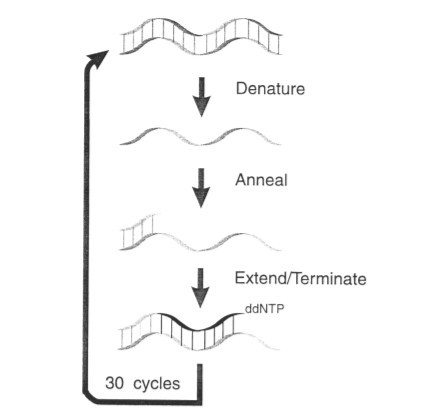
The technique's distinguishing feature is its incorporation of thermal cycling, which dramatically improves sequencing efficiency. Unlike conventional Sanger sequencing's single-phase synthesis, cycle sequencing employs repeated temperature cycles (denaturation, annealing, and extension) to:

- Improve signal strength from limited DNA samples
- Enhance sequencing reaction consistency
- Enable processing of challenging templates
Specialized Polymerase Utilization
A thermo-stable DNA polymerase (typically Taq polymerase) drives the sequencing reactions. This enzyme's heat resistance allows it to withstand repeated high-temperature cycles while maintaining:
- Consistent polymerization activity
- High nucleotide incorporation fidelity
- Reliable performance across numerous thermal cycles
Fluorescent Detection Systems
Modern implementations use fluorescently labeled primers or terminators for sequence detection. These markers enable:
- Precise fragment size determination
- Automated data collection
- High-throughput analysis capabilities
- Digital sequence interpretation
Technical Workflow Overview
The complete cycle sequencing process involves:
- Template preparation (double or single-stranded DNA)
- Cyclic reaction phases (typically 25-35 cycles)
- Electrophoretic separation (capillary or gel systems)
- Fluorescent signal detection
- Computational sequence assembly
Figure 1: Schematic representation of cycle sequencing workflow showing template cycling through denaturation, annealing, and extension/termination phases (adapted from Kretz et al., 2024).
Comparative Analysis: Cycle Sequencing vs. Related Techniques
| Feature | PCR | Cycle Sequencing | Traditional Sanger |
|---|---|---|---|
| Primary Objective | DNA amplification | Sequence determination | Sequence determination |
| Thermal Cycling | Required | Required | Not used |
| Key Enzymes | Taq polymerase | Thermostable polymerase | DNA polymerase |
| Output | Amplified DNA copies | Sequence data | Sequence data |
| Throughput Capacity | High | Very High | Limited |
| Typical Applications | Target amplification | Genomic sequencing | Small fragment analysis |

Advantages Over Conventional Methods
Cycle sequencing offers significant improvements:
- Enhanced Sensitivity: Works with minute DNA quantities
- Superior Efficiency: Processes multiple samples simultaneously
- Increased Accuracy: Reduces sequencing artifacts
- Automation Compatibility: Adapts to high-throughput platforms
- Cost Effectiveness: Lowers per-sample expenses
Research Applications
This technology enables:
- Whole genome sequencing projects
- Mutation detection and analysis
- Microbial strain identification
- Forensic DNA profiling
- Ancient DNA studies
- Clinical diagnostic testing
Conclusion
As a refined iteration of Sanger sequencing, cycle sequencing represents a critical advancement in molecular genetics. Its integration of thermal cycling principles with chain-termination chemistry has created a versatile platform that continues to support cutting-edge genomic research across diverse scientific disciplines.