

Introduction
The automotive industry is undergoing a technological revolution, with sensor and camera technologies playing a crucial role in vehicle automation, safety, and enhanced driving experiences. These advanced systems enable driver assistance, collision prevention, and autonomous navigation, significantly improving vehicle intelligence.
The demand for automotive sensors and cameras has surged due to rising safety regulations, growing adoption of autonomous vehicles, and consumer preferences for smart driving solutions. From advanced driver-assistance systems (ADAS) to in-vehicle monitoring, these technologies are shaping the future of transportation.
The Evolution
Automotive sensors have evolved from basic mechanical components to highly sophisticated electronic systems. Early vehicle sensors focused on monitoring engine performance and fuel efficiency. With advancements in machine vision and AI, sensors now support adaptive cruise control, lane-keeping assistance, and object detection.

Camera systems were initially used for rearview monitoring, but have expanded to 360-degree vision, night vision, and real-time facial recognition for driver behavior analysis. The integration of LiDAR, radar, and ultrasonic sensors enhances vehicle automation, pushing the industry toward fully autonomous driving solutions.
Market Trends
Several trends are driving the automotive sensor and camera market. ADAS adoption is growing, with features like automatic emergency braking and pedestrian detection becoming standard in new vehicles. Sensor fusion technology, combining LiDAR, radar, and cameras, is optimizing autonomous vehicle performance.
The emergence of AI-powered driver monitoring systems improves safety by detecting drowsiness and distractions. Thermal imaging cameras are gaining traction for enhanced visibility in low-light conditions. Connected vehicle technologies, integrating cloud-based data analytics, support real-time hazard detection.
Governments worldwide are enforcing stricter automotive safety regulations, promoting the inclusion of advanced sensor systems in all vehicle segments. Miniaturization and cost reduction efforts are making these technologies more accessible to mass-market automobiles.
Challenges
Despite advancements, the market faces challenges. High development and manufacturing costs limit affordability for budget-segment vehicles. Complex integration of multiple sensor systems increases vehicle design complexity.

Cybersecurity concerns arise with cloud-connected sensor networks, requiring robust encryption and data protection measures. Standardization issues across different automotive brands complicate interoperability in smart vehicle ecosystems. The transition to fully autonomous vehicles requires extensive infrastructure upgrades and regulatory approvals.
Market Scope
The automotive sensor and camera market spans passenger vehicles, commercial fleets, electric vehicles (EVs), and autonomous driving technologies. Applications include ADAS, collision avoidance systems, gesture recognition, and in-cabin monitoring.
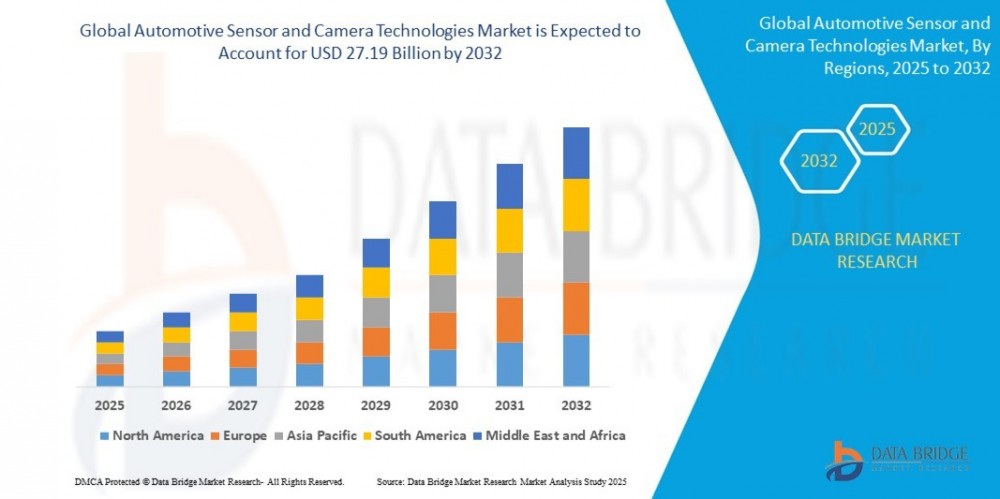
North America leads the market due to high adoption of smart vehicle technology and stringent safety mandates. Europe follows closely, benefiting from strong regulatory frameworks supporting autonomous driving advancements. Asia-Pacific is witnessing rapid expansion, driven by EV development, urban mobility initiatives, and AI-driven automotive solutions.
Market Size
The market is experiencing exponential growth, fueled by the rise in electric and autonomous vehicles. Financial projections indicate steady expansion, driven by high consumer demand for safety-enhancing and self-driving technologies.
Increasing collaborations between automotive manufacturers and tech companies accelerate research and development efforts. LiDAR and AI-based imaging systems are expected to dominate the market in the coming years, reinforcing industry growth.
Factors Driving Growth
Several factors contribute to market growth. Safety concerns and regulatory mandates are pushing automakers toward advanced sensors and camera systems. AI and machine learning advancements are optimizing driver-assistance capabilities.
The rise of smart cities and intelligent transportation networks supports demand for connected vehicle technologies. EV growth and autonomous driving innovations fuel market expansion. Cost-effective sensor miniaturization and integration enhance adoption in mainstream vehicles.
Other Trending Reports
https://www.databridgemarketresearch.com/reports/global-data-resiliency-market
https://www.databridgemarketresearch.com/reports/global-silicon-carbide-fibers-market
https://www.databridgemarketresearch.com/reports/global-miticides-market
https://www.databridgemarketresearch.com/reports/global-vital-signs-monitoring-equipment-market
https://www.databridgemarketresearch.com/reports/global-non-small-cell-lung-cancer-market
https://www.databridgemarketresearch.com/reports/global-substitute-natural-gas-market





