

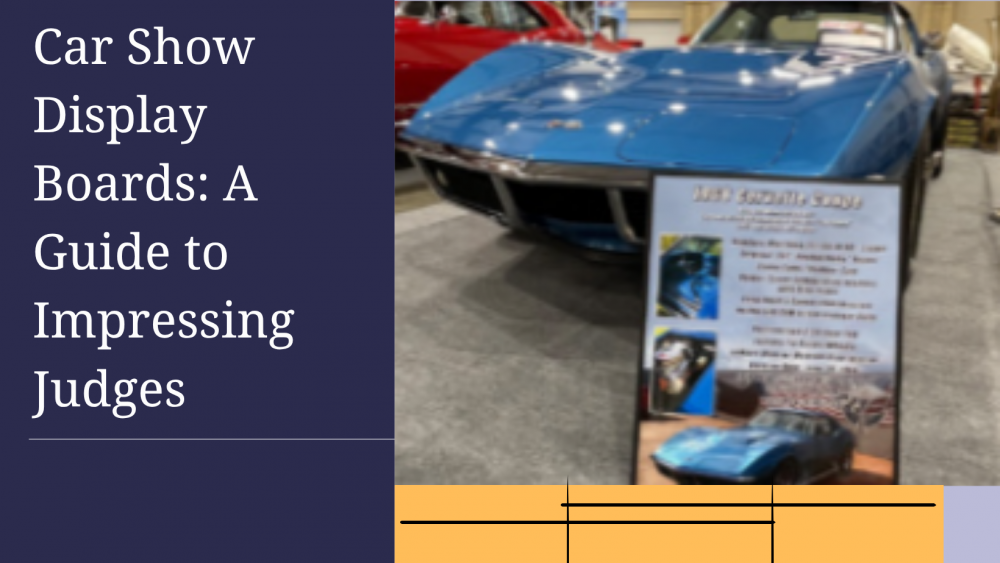
You’ve spent hundreds of hours in the garage. You’ve buffed the paint until it reflects like a mirror, detailed the engine bay until it’s cleaner than your kitchen, and polished every inch of chrome until it blinds passersby. You load up the trailer, head to the local meet, and roll your pride and joy onto the show field.
But as the day goes on, you notice something. People walk past your car, glance at the engine, and keep moving. They don't linger. They don't ask questions. Meanwhile, the car parked three spots down has a crowd around it, deep in conversation.
What’s the difference?
It’s not just the car. It’s the story. More specifically, it’s the car show sign board sitting right next to that other vehicle.
In the competitive world of car shows—whether it’s a local Cars & Coffee, a prestigious Concours d’Elegance, or a massive NSRA event—your display is just as important as your ride. A high-quality, professional sign board acts as your silent salesman, telling the story of your build when you aren't there to tell it yourself.
In this comprehensive guide, the team at Boards By Nick is breaking down everything you need to know about car show sign boards. We’ll cover why they matter, what information you need to include, design tips for maximum impact, and how the right board can be the difference between going home empty-handed and taking home the "Best in Show" trophy.
Why Car Show Sign Boards Are Non-Negotiable
If you’ve ever attended a car show, you know the feeling. You see a stunning vehicle, but the hood is down, the owner is nowhere to be found, and you have no idea what’s under the sheet metal. Is it a numbers-matching original? Is it a restomod with a modern LS swap? You move on because the mystery is too much effort to solve.
This is exactly why car show sign boards are essential. They bridge the gap between the spectator and the vehicle.
1. They Tell the Story
Every car has a soul, but that soul is invisible without context. A 1969 Camaro is just a car. But a 1969 Camaro that was pulled from a barn in Ohio and restored by a father-and-son duo over three years? That is a legacy. A sign board captures that narrative, engaging the audience emotionally. People love a backstory, and Boards By Nick specializes in helping you tell that story visually.

2. They Answer the FAQs
Car shows are social events, but as an owner, you can’t be at your car 24/7. You need to grab a burger, check out the other rides, or use the restroom. A sign board answers the constant stream of questions: "What size motor is that?" "Is that the original color?" "How much horsepower does it put down?" It allows spectators to self-educate, freeing you up to enjoy the show while your display does the heavy lifting.
3. They Show Professionalism
Let’s be honest: presentation counts. A car with a wrinkled piece of paper taped to the windshield looks amateur. A car with a sleek, professional corrugated plastic or aluminum sign board looks like a contender. Judges often look at the total package—vehicle condition, cleanliness, and display quality. A great sign board signals that you care about the details.
The Anatomy of a Perfect Car Show Board
So, you’re sold on the idea. But what exactly goes on a car show sign board? You don’t want to clutter it with a novel, but you need more than just a logo. Here at Boards By Nick, we recommend a specific layout that balances information with visual appeal.
The Header
This is the first thing people see. It needs to be bold and legible from ten feet away.
- Year, Make, and Model: (e.g., 1957 Chevrolet Bel Air)
- Nickname: If your car has a name like "The Beast" or "Ol' Blue," put it here.
- Owner Name: Give yourself credit!
Vehicle Specifications (The "Stats")
This is the meat of the board. Car guys (and gals) love specs. This section usually includes:
- Engine: Displacement, modifications, fuel injection vs. carburetor.
- Transmission: Automatic, manual, gear ratios (if relevant).
- Rear End/Gear Ratio: Essential for drag racing or street rod classes.
- Wheels & Tires: Brand, size, and type.
- Paint & Interior: Color codes and upholstery materials.
The Build Story
This is where you win the hearts of the crowd. Keep it concise—about 3 to 5 sentences.
- History: How did you get the car? Was it a barn find?
- The Process: Was it a frame-off restoration? A daily driver?
- Unique Features: Did you fabricate custom parts? Is there a hidden stereo system?
Imagery
While the car is sitting right in front of them, showing photos of the process is incredibly powerful.
- Before Photos: Show the rust, the dents, or the stripped frame. It highlights the transformation.
- Engine Bay/Undercarriage: If the hood is closed due to weather, a photo of the engine on the board ensures people still see your hard work.
Materials Matter: Foam Core vs. Coroplast vs. Aluminum
Not all car show sign boards are created equal. Depending on where you show your vehicle, the material choice can make a huge difference.
Coroplast (Corrugated Plastic)
This is the industry standard for outdoor car shows. It’s lightweight, waterproof, and durable. If you are parking on grass or in a field, Coroplast is your best friend. It won't get ruined by morning dew or a sudden rain shower. Boards By Nick offers high-quality Coroplast printing that resists fading, ensuring your board looks vibrant season after season.
Foam Board
Foam board is rigid and has a smooth, high-end finish. It looks fantastic for indoor shows, trade displays, or Concours events where the car is on a polished floor. However, it is not water-resistant. If you plan on showing outdoors, foam board is a risky choice as it can warp or dissolve if it gets wet.
Aluminum
For the ultimate in durability and prestige, aluminum sign boards are the top tier. They are rust-proof, rigid, and offer a sleek metallic finish that screams high-end. They are heavier and more expensive, but they withstand wind, rain, and sun without bending. If you have a six-figure build, an aluminum board from Boards By Nick matches the quality of your vehicle.
Design Tips to Make Your Board Pop
You have the content; now you need the design. A cluttered board is just as bad as no board at all. Here are a few American design principles we use to ensure readability and impact.
Font Selection
Avoid overly decorative fonts (like Old English or Papyrus) that are hard to read. Stick to clean, bold Sans-Serif fonts for headers (like Arial, Helvetica, or Impact) and a readable Serif font for the story body. The font size for your main specs should be at least 24pt to 30pt so older spectators can read it easily.
Color Contrast
High contrast is key.
- Good: White text on a black board, or black text on white.
- Bad: Dark blue text on a black background, or yellow text on white. If your car is a specific color, you might be tempted to match the board background to the paint. Be careful—this can sometimes make the text hard to read. When in doubt, stick to classic high-contrast color schemes.
The "Logo" Placement
If your car is sponsored by a shop, or if you are part of a car club, include those logos! Place them in the bottom corners or footer of the board. It shows community support and gives a shout-out to the people who helped you build the car. Boards By Nick can integrate vector logos seamlessly into your design to ensure they look crisp and professional.
DIY vs. Professional Printing: The Cost Breakdown
Many first-time show-goers consider making their own sign board with a sharpie and a poster board from the dollar store. Let’s talk about why that usually ends up hurting your chances.
The DIY Route
- Pros: Inexpensive upfront ($5 - $15). Easy to fix mistakes with a new sheet of paper.
- Cons: Looks unprofessional. Fades quickly. Can blow away in a light breeze. Handwriting is often hard to read. It signals "amateur hour" to the judges.
The Professional Route (Boards By Nick)
- Pros: High-resolution graphics. Weather-resistant materials. Custom shapes and cutouts. Glossy finish that catches the light. Judged as part of the "display" criteria.
- Cons: Higher initial investment ($50 - $150 depending on size/material).
However, think of it this way: You likely spent thousands on parts, paint, and polish. Spending a fraction of that on a professional board protects your investment. It turns your car from a "static display" into a "show-winning exhibit."
Common Mistakes to Avoid with Car Show Sign Boards
As we review thousands of entries here at Boards By Nick, we see a few common pitfalls that trip people up.
- Information Overload: Do not list every single bolt and screw. If your board looks like a dense encyclopedia, people won't read it. Use bullet points to break up text.
- Bad Photos: A blurry iPhone photo printed large looks terrible. Use high-resolution images. If you don't have a good camera, hire a photographer for an hour or ask a friend with a DSLR.
- Wrong Size: A tiny 8x11 sheet of paper looks lost next to a massive muscle car. Conversely, a massive 4x8 board can overpower a small street rod. A standard 18x24 or 24x36 inch board is usually the sweet spot for most vehicles.
- No Contact Info: If you are away from your car and someone wants to buy it or talk shop, you’ve missed an opportunity. Include a QR code linking to your Instagram or email, or simply place "For Sale" tabs with your number if applicable.
Weatherproofing and Display Hardware
You’ve got your board from Boards By Nick. Now, how do you display it?
Easels and Stands
For indoor shows, a wooden or metal easel is classic. For outdoor shows, wind is your enemy. A lightweight easel can topple over, scratching your board or hitting your car.
- Pro Tip: Use a heavy-duty steel wire easel. You can often slide the legs under the tires of your car (carefully) to anchor it, or use tent stakes if you are on grass.
The "Wind Flap" Technique
If you are using Coroplast, it naturally handles wind better than rigid foam because it has a little flex. However, on extremely windy days, consider attaching a small weight to the bottom edge of the board using fishing line and a washer, or secure the board to the easel with zip ties.
How Boards By Nick Helps You Win
You want your car to be remembered. You want people to snap photos of your engine bay and your display. We get it. That’s why Boards By Nick isn't just a printing shop; we are car enthusiasts ourselves.
We understand the culture. We know the difference between a Hemi and a Hemi clone. We know that "numbers matching" matters. We work with you to design a layout that highlights the unique features of your specific build. Whether you are rolling in a classic Ford truck, a JDM tuner, a European exotic, or an American muscle car, we have the templates and the expertise to make your sign board shine.
We offer:
- Custom Designs: No templates. Your car, your story, your way.
- Durable Materials: Weather-resistant options for the show season.
- Fast Turnaround: Got a show next weekend? We’ve got you covered.
- Competitive Pricing: Professional quality without breaking the bank.
Conclusion
Your car is a masterpiece. Don't let it sit in silence. A car show sign board is not just a placard; it is a voice for your vehicle. It educates the judges, entertains the crowd, and validates the thousands of dollars and hours you poured into your hobby.
As you prepare for the upcoming show season, don't leave the garage without the final piece of the puzzle. Invest in a high-quality, professionally designed sign board. Whether you need a simple spec sheet or a full-blown storyboard, Boards By Nick is here to help you cross the finish line in style.





