
You’ve spent countless hours in the garage. You’ve buffed the paint until it gleams, detailed the engine bay to perfection, and polished the chrome until you can see your reflection in it. You arrive at the car show, pop the hood, and step back, expecting the crowds to gather.
But there’s a problem. The car next to you a similar model, perhaps in slightly rougher shape has a crowd three deep. Why? Because the owner is telling a story. They aren’t just displaying a machine; they are displaying a narrative, thanks to a professional, eye-catching show board.
In the competitive world of car shows, a vehicle is only as good as the story it tells. Whether you are cruising into a local meet in a slammed Mini Truck or rolling a pristine classic muscle car onto the fairway at Pebble Beach, the difference between a "nice car" comment and a trophy often comes down to presentation.

At Car Show Boards, we know that your display is the bridge between your hard work and the audience’s appreciation. A well-designed board does more than list specs; it invites the viewer in, educates the judge, and adds that final layer of polish that screams "champion."
This guide covers everything you need to know about creating winning car show display board ideas that capture attention and respect.
Why You Absolutely Need a Show Board
Before we dive into design ideas, let's address the skeptics. Some purists believe the car should speak for itself. While that is a romantic notion, it ignores the reality of car show judging and spectator behavior.
1. The "Hood Up" Dilemma
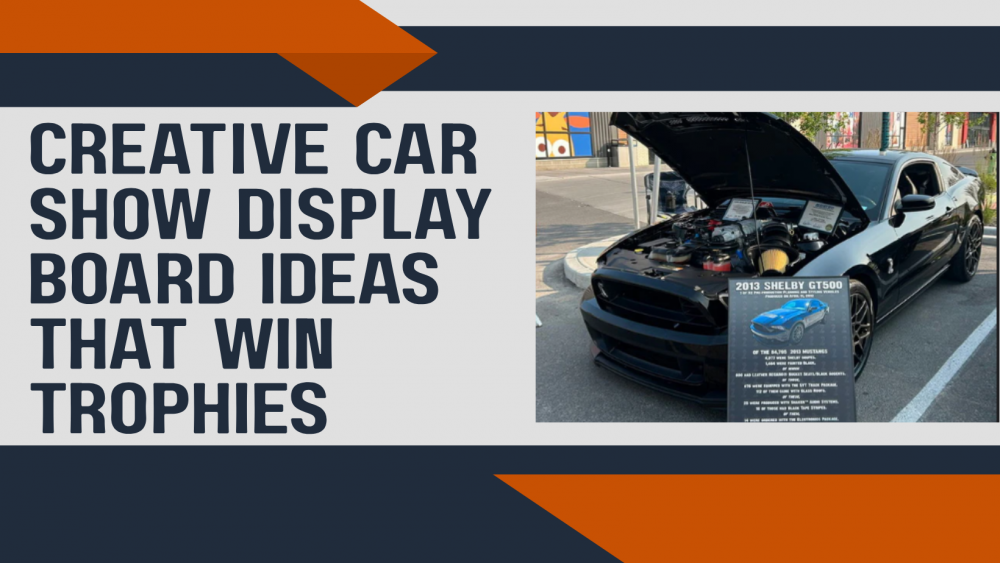
If you are showing a muscle car or hot rod, you likely pop the hood to show off that chrome-laden engine. But when the hood is up, it blocks the view of the fender and the engine itself from certain angles. A strategically placed car show board allows spectators to see the specs and modifications without craning their necks. It serves as a proxy for the information hidden under the steel.
2. Engaging the Spectators
Most spectators at a car show are not experts on your specific make and model. They might look at a Ford Falcon and see just an old car. But if they see a board detailing a rare "Sprint" package or a resto-mod engine swap, suddenly they are engaged. They are learning. You transform from "person with a car" to "educator and enthusiast."

3. The Judges' Best Friend
Judges have to evaluate dozens, sometimes hundreds, of vehicles in a single day. They are tired, the sun is hot, and they are rushing. If they have to hunt for a spec sheet or ask you questions you might not be there to answer, they might move on. A concise, clear show board ensures they see every modification and correct detail instantly. It makes their job easier, and that goodwill translates to points.
Essential Elements: What Goes on a Car Show Board?
Before getting creative with the "ideas" part, we need to lock down the foundation. Every effective board, regardless of design style, must contain specific data points.
The Basics
- Year, Make, and Model: This seems obvious, but you’d be surprised how often it’s overlooked.
- Owner Name/Hometown: Adds a personal touch.
- Club Affiliation: If you belong to a car club, display the logo.
The "Under the Skin" Details
This is where you win points. Don't just say "350 Engine." Be specific.
- Engine: Displacement, horsepower, torque, carburetor/injection details.
- Transmission: Auto or manual? Gear ratios?
- Wheels & Tires: Brand, size, and any modifications needed to fit them.
- Paint & Body: Color name, number of coats, custom bodywork (shaved door handles, etc.).
The Narrative
This is the secret sauce. A bullet list is boring. A story is memorable.
- Restoration History: How long did it take? Was it a barn find?
- Unique Provenance: Did this car win a race in 1974? Was it owned by a celebrity?
- Future Plans: Shows you are committed to the hobby.
Car Show Display Board Ideas to Inspire You
Now that we have the data, let’s talk design. At Car Show Boards, we see trends come and go, but a few styles consistently stand out. Choose the one that matches your car’s personality.
1. The "Spec Sheet" Style (Clean & Professional)
This is the classic approach. It focuses on readability and information density. It typically features a large photo of the car in the center, surrounded by organized text blocks detailing the build.
- Best For: Show cars, resto-mods, and high-end restorations where the focus is on the quality of the build.
- Design Tip: Use high-contrast colors. Black text on white is easiest to read in bright sunlight. Use "bullet points" for specs so people can scan quickly.
- Why it Works: It looks official. It mimics the spec sheets manufacturers used to hand out at dealerships in the 60s.
2. The "Before and After" Storyboard
Nothing garners more respect than a full restoration documented visually. This board features a split design: one side showing the car as a rusty shell or barn find, the other showing the finished masterpiece.
- Best For: Restorations, barn finds, and heavily modified project cars.
- Design Tip: Ensure the "before" photos are clear. Use captions like "Found in a field, 2018" and "Completed, 2023."
- Why it Works: It proves your skill and dedication. It stops the "did you buy it like that?" questions instantly. It validates the massive amount of work you put into the vehicle.
3. The Theme Board
Does your car have a personality? A 1950s Chevy Bel Air might benefit from a "Diner" theme board, utilizing retro fonts, checkerboard borders, and neon color schemes. A JDM import might use a "Tokyo Drift" aesthetic with cyber-graphic backgrounds.
- Best For: Lowriders, cruisers, and highly stylized builds.
- Design Tip: Don't let the theme overpower the text. The font must remain legible against the background graphics.
- Why it Works: It creates an emotional atmosphere. It sets the mood before the viewer even reads a word.
4. The "Exploded View" or Technical Board
For the engineering enthusiasts, this board focuses on the mechanics. Instead of a photo of the car, the main graphic might be a blueprint, an exploded engine diagram, or a close-up photo of the engine bay with arrows pointing to specific, rare components.
- Best For: Muscle cars, hot rods, and race cars.
- Design Tip: Use arrows and lines to connect text to specific parts in the photo. This looks incredibly technical and impressive.
- Why it Works: It appeals to the gearheads. It shows that you know every nut and bolt of your machine.
5. The Memorial / Tribute Board
Many cars are preserved in memory of a loved one. A tribute board combines the specs of the car with photos of the person it honors, perhaps standing next to the car decades ago.
- Best For: Survivor cars and family heirlooms.
- Design Tip: Keep the tone respectful. Use elegant, serif fonts.
- Why it Works: It connects the car to human history. It often brings a tear to the eye and ensures your car is remembered long after the show ends.
Material Matters: Choosing the Right Hardware
The content is king, but the presentation is queen. You can have the best car show display board ideas in the world, but if they are printed on flimsy paper, they will fail.
Corrugated Plastic (The Standard)
Often called "Yard Sign" material, this is lightweight, waterproof, and affordable. It’s perfect for the casual cruiser.
- Pros: Cheap, durable against rain, lightweight.
- Cons: Can blow away in the wind; looks a bit "DIY" for high-end shows.
PVC Board (The Professional Choice)
This is the industry standard for serious show winners. It is a solid plastic board that doesn't bend. It has a smooth, matte finish that eliminates glare—a crucial factor when the sun is beating down on the fairgrounds.
- Pros: Rigid, professional appearance, glare-resistant (if matte), waterproof.
- Cons: Heavier than corrugated; slightly more expensive.
Retractable Banner Stands
If you have a larger space or an indoor booth, a retractable banner (like a trade show banner) offers a massive canvas for your design.
- Pros: Huge visibility, easy to transport (base holds the banner), very stable.
- Cons: Can blow over outdoors if not weighted; takes up floor space.
At Car Show Boards, we highly recommend the PVC route for most enthusiasts. It strikes the perfect balance between professional rigidity and ease of transport. It signals to the judges that you invested in your display, just as you invested in your chrome.
Design Tips for Maximum Readability
You don’t need to be a graphic designer to create a great board, but you do need to follow some basic rules of visual hierarchy.
Watch Your Fonts
Avoid overly decorative fonts like "Old English" or "Brush Script" for your main body text. They are impossible to read from a distance or by older spectators. Use a bold, clean Sans-Serif font for the main text (like Arial or Helvetica) and save the fancy fonts for the headers or your name.
The 3-Foot Rule
Print your design out (or view it on screen) and step back three feet. Can you read the specs? If not, your font is too small. Remember, car shows are bright and crowded. Make it easy for people to read while walking by.
Color Contrast
Red text on a black background is a nightmare to read. Blue text on a black background is invisible in the shade. Stick to the basics:
- White background / Black text (Highest readability)
- Black background / White text (Sleek, but ensure the font is thick)
- Avoid neon colors that strain the eyes.
Image Resolution
A blurry photo ruins the board. Ensure any images you use are at least 300 DPI (dots per inch). If you pulled a photo off Facebook or Instagram, it is likely low resolution and will look pixelated when blown up to poster size. At Car Show Boards, we always advise clients to send us the original high-res files from their cameras.
Common Mistakes to Avoid
As you brainstorm your car show display board ideas, watch out for these pitfalls that can ruin an otherwise great display.
1. The "Wall of Text"
Do not write a novel. Spectators have an attention span of about 30 seconds at a booth. If they see a paragraph of 500 words, they will walk away. Keep it punchy. Use bullet points. If you have a long story, put it on the back of the board or in a binder on your table.
2. Spelling and Grammar Errors
Nothing kills credibility faster than spelling "Corvette" wrong or mixing up "their" and "there." Proofread your board five times. Then have a friend proofread it. A typo on a permanent board looks unprofessional.
3. Outdated Information
If you install a new supercharger in 2024, make sure your board doesn't list the old stock horsepower. Your board should be a living document. If you change the car, update the board. If you buy a pre-made template, ensure you can edit it easily, or order a new one from us when you upgrade your parts.
4. No Contact Info
You might not be at your car when a potential buyer or a magazine editor walks by. Always include an email address or social media handle (Instagram is king in the car world) so people can reach you.
Elevating Your Display Beyond the Board
Once you have your perfect show board, how do you display it?
The Easel
A simple wire easel is the most common method. However, wire easels can be flimsy. We recommend a sturdy wooden or metal display easel. If you are on grass, make sure the legs are wide enough to not sink into the dirt.
The Tabletop
If you have a swap meet style setup with a folding table, place the board on the table behind your merchandise. It acts as a backdrop. You can lean it against a wall or a box, but securing it so it doesn't slide is important.
The Custom Stand
For the ultimate show car, some builders fabricate custom steel stands that match the wheels or paint theme of the car. This is extreme, but it shows the level of detail that wins "Best in Show."
Where to Get Your Show Boards
You have the ideas. You have the photos. Now, you need the product.
While you can head to a local print shop, they often don't understand the specific needs of the car community. They might use glossy paper that blinds spectators in the sun, or materials that melt in the trunk of your hot rod.
At Car Show Boards, we specialize in serving the automotive community. We understand that you need UV-resistant inks so the sun doesn't fade your board after one season. We know you need materials that can withstand a little grease and grime. We offer customizable templates and fully custom designs that ensure your vehicle gets the respect it deserves.
Whether you need a simple spec sheet or a full "Before & After" storyboard, we are here to help you cross the finish line in style.
Conclusion
Your car is a reflection of your passion. It deserves more than a handwritten piece of paper taped to the window. It deserves a display that tells its story, highlights its strengths, and engages the community.
Creative car show display board ideas are not just about showing off; they are about sharing your journey. Whether you choose a technical blueprint style or a nostalgic theme board, the investment in presentation pays off in trophies, conversation, and memories.
Don't let your hard work go unnoticed. Upgrade your display, tell your story, and let Car Show Boards help you bring home the gold.





