
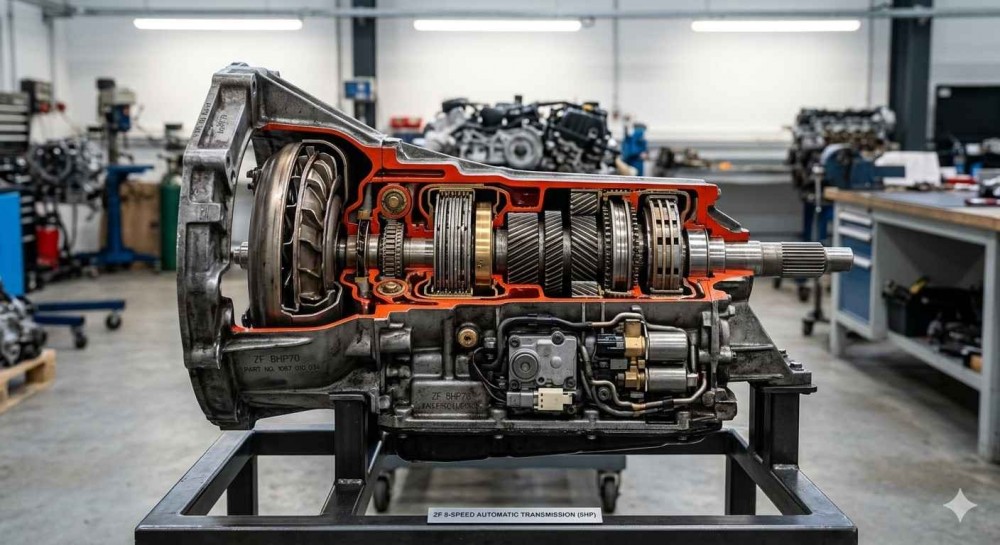
Honda's automatic transmissions have a nuanced reliability history that every buyer should understand before purchasing a used unit. Honda's automatics are generally well-engineered and durable, but specific generations had documented problems that are important to understand:
2000 to 2004 Honda Odyssey and Accord V6 Transmission Failures — This generation of Honda V6 automatics is widely known for premature failure, typically occurring between 80,000 and 130,000 miles. The third gear clutch pack was a specific weak point. Honda extended warranty coverage on these units and offered reimbursement programs for some affected owners. When purchasing a used transmission for this generation, confirm it is not from a donor vehicle that experienced the same failure.
Honda Civic and Accord Four-Cylinder Automatics — The four-cylinder automatics across multiple Honda generations are generally more reliable than the V6 units of the problematic era, with documented longevity exceeding 200,000 miles in well-maintained examples.

Honda CVT Reliability — Honda's CVT is a well-designed unit that performs reliably when the correct Honda HCF-2 CVT fluid is used and changed every 40,000 miles. CVTs in vehicles where the fluid was treated as a lifetime fill have documented shudder and slip issues that are often preventable with proper maintenance.
Used Honda Transmission for Sale: Complete Buyer's Guide
If you are searching for a used Honda transmission for sale, you are looking to preserve one of the most dependable vehicles on the road with a cost-effective solution that makes complete financial sense. Honda has earned a global reputation for building vehicles that run reliably for extraordinary mileages, and the transmissions that power these vehicles are a central part of that legacy. From the Civic and Accord to the CR-V, Pilot, Odyssey, and Ridgeline, Honda's vehicle lineup spans a broad range of applications, each with specific transmission requirements that must be understood before making a purchase. This comprehensive guide covers everything you need to know about finding, evaluating, and purchasing a quality used Honda transmission that restores your vehicle to full reliable function.
Why Honda Vehicles Are Worth a Transmission Replacement
The financial case for replacing a transmission in a Honda vehicle is stronger than for almost any other manufacturer, and the reason comes down to Honda's fundamental engineering philosophy. Honda designs its vehicles to last, and in practice that means the engines, chassis structures, body panels, and interiors of Honda vehicles routinely outlast the transmission by a significant margin when the transmission develops problems. A Honda Accord or CR-V with a failed transmission typically has an engine that has hundreds of thousands of miles remaining in it, a body that is structurally sound, and an interior that reflects the quality Honda builds into its vehicles. Replacing the transmission rather than the vehicle is almost always the economically rational decision for a Honda owner, which is exactly why the market for used Honda transmissions is one of the most active in the industry.
Honda's Major Transmission Types
Honda has used several distinct transmission families across its lineup, and understanding which type is in your specific vehicle is the essential first step:
Honda Automatic Transmissions (BAXA, MAXA, SKYA, MGFA, and related) — Honda uses a series of electronically controlled automatic transmissions across its lineup that differ by torque rating, gear count, and application. Earlier Civic and Accord automatics used four-speed units while later models transitioned to five-speed and eventually continuously variable transmissions.

Honda CVT (Continuously Variable Transmission) — Deployed extensively across newer Civic, Accord, CR-V, HR-V, and Fit models. Honda's CVT uses a proprietary belt-and-pulley design with specific fluid requirements and service needs that differ fundamentally from conventional automatics.
Honda Dual-Clutch Transmission (DCT) — Used in some Civic Sport and Accord Sport configurations, particularly with the 1.5L and 2.0L turbocharged engines. A seven-speed unit that combines the fuel efficiency of a manual with the convenience of an automatic but requires specific break-in and service procedures.
Honda 6-Speed Automatic — Used in the Accord V6, Pilot, Ridgeline, Passport, and Odyssey. A robust and well-regarded unit that handles higher torque outputs from V6 engines across Honda's family hauler and truck-based lineup.
Honda 9-Speed Automatic — Used in newer Accord, CR-V, and Pilot models in collaboration with ZF. A more complex unit with specific electronic integration requirements.
Honda Manual Transmissions — Honda's manual gearboxes, used across the Civic, Accord, and CR-V in various configurations, are known for their precise feel and exceptional durability. Used Honda manual transmissions are widely sought by enthusiasts and practical owners alike.
Common Problems That Lead to Honda Transmission Replacement
Third Gear Clutch Pack Failure — Primarily affects 2000 to 2004 V6 automatics in the Accord and Odyssey. Causes the transmission to slip in third gear or skip third gear entirely. When purchasing a used transmission for this application, ask specifically whether the donor transmission exhibited third gear issues.
Torque Converter Clutch Shudder — Common across multiple Honda automatic generations when fluid maintenance has been deferred. Honda requires ATF-Z1 or DW-1 depending on the model year, and using generic ATF accelerates the TCC wear that causes shuddering.
CVT Belt and Pulley Wear — Honda CVTs that have operated with degraded HCF-2 fluid develop belt slip that causes shuddering during light-throttle acceleration. A fluid service resolves early-stage shudder but advanced pulley surface wear requires CVT replacement.
Solenoid and Shift Quality Issues — Electronic shift solenoids in Honda automatics are documented wear items at higher mileages. Failed solenoids cause erratic shifting, stuck gears, and transmission fault codes that are sometimes misdiagnosed as more serious internal failures.
Dual-Clutch Hesitation — Honda's DCT in the Civic and Accord exhibits the low-speed hesitation inherent to dual-clutch designs in stop-and-go traffic. Software updates from Honda dealers address the most significant manifestations of this behavior.
How to Find and Evaluate a Used Honda Transmission
Finding a reliable used Honda transmission requires a systematic approach that prioritizes documentation and verification over price alone:
Provide your full VIN to the seller. Honda's transmission coding system is specific enough that even transmissions from the same model year and engine can have different specifications based on production date and market configuration. Your VIN allows precise cross-referencing that eliminates compatibility uncertainty.
Ask specifically about the known failure history for your generation. If you own a 2000 to 2004 Accord V6 or Odyssey, ask the seller directly whether the donor transmission experienced third gear issues before being pulled. A reputable seller will answer this question honestly.
Request a fluid condition report. Honda ATF formulations have a distinctive red color and transparent clarity when in good condition. Darkened, burnt-smelling, or metallic-particle-laden fluid is a reliable indicator of internal wear regardless of mileage.
Verify solenoid function. Ask whether the shift solenoids were tested before the transmission was listed. Non-functioning solenoids add repair cost and complexity to the installation project.
Confirm the warranty terms in writing. A reputable used Honda transmission supplier should offer at least 30 days warranty coverage and ideally 90 days or longer. Written warranty terms that cover both the part and reasonable labor costs are a meaningful indicator of supplier confidence.
Honda Transmission Fluid: The Most Critical Maintenance Factor
Honda is one of the manufacturers most insistent about transmission fluid specifications, and the consequences of using the wrong fluid in a Honda transmission are well-documented:
Honda ATF-Z1 — Required for older Honda automatic transmissions. Not interchangeable with Dexron, Mercon, or any generic ATF. Using the wrong fluid causes rapid clutch pack degradation and solenoid contamination.
Honda DW-1 — The current specification for Honda automatic transmissions, replacing ATF-Z1 in most current applications. DW-1 is backwards compatible with ATF-Z1 applications and is the recommended fluid for most modern Honda automatics.
Honda HCF-2 — The proprietary CVT fluid for Honda CVT-equipped vehicles. Not interchangeable with any conventional ATF or generic CVT fluid. Using the wrong fluid in a Honda CVT causes rapid and irreversible belt surface damage.
Honda MTF — The manual transmission fluid for Honda manual gearboxes. A specific formulation that provides the correct friction characteristics for Honda's synchronizer design.
After installing any used Honda transmission, always fill with the correct Honda-specified fluid to the correct level before starting the engine.
Pricing for Used Honda Transmissions
The broad availability of used Honda transmissions from the manufacturer's enormous vehicle population creates competitive and accessible pricing:
Honda Civic four-speed or five-speed automatic: $300 to $800
Honda Accord four-cylinder automatic: $350 to $900
Honda Accord V6 six-speed automatic: $500 to $1,400
Honda CR-V automatic: $400 to $1,000
Honda Pilot or Odyssey six-speed automatic: $600 to $1,500
Honda CVT from Civic or Accord: $600 to $1,500
Honda manual transmissions: $300 to $900 depending on model and condition
Remanufactured Honda transmissions typically range from $1,200 to $3,500 depending on the unit and rebuild scope.
Installation Considerations for Used Honda Transmissions
Honda transmission installation varies by model and drivetrain configuration:
Front-wheel-drive Civic and Accord four-cylinder: $600 to $1,200 in labor
Front-wheel-drive Accord V6: $800 to $1,400 due to additional drivetrain complexity
Honda CR-V and HR-V all-wheel-drive: $800 to $1,500
Honda Pilot and Odyssey: $900 to $1,600
Honda Ridgeline: $900 to $1,700
During installation, replace the transmission fluid, filter, and all axle shaft seals simultaneously to protect the service life of the replacement unit.
Frequently Asked Questions
How much does a used Honda transmission cost? Prices range from $300 for older Civic automatics to $1,500 for Pilot or Odyssey six-speed units. Most commonly replaced models fall between $400 and $1,200 depending on mileage and condition.
What is the most reliable Honda automatic transmission? The six-speed automatics used in the post-2005 Accord V6, Pilot, and Odyssey are generally regarded as Honda's most durable automatic units. The four-cylinder automatics across multiple generations also have excellent long-term reliability records.
What fluid does a Honda Accord transmission use? Honda DW-1 ATF for most current automatic applications. Older models may require ATF-Z1. CVT-equipped Accords require Honda HCF-2 CVT fluid. Never substitute generic ATF.
How long does a used Honda transmission last? A quality used Honda transmission from a documented low-mileage donor can provide 120,000 to 200,000 miles of additional service with correct Honda-specified fluid maintenance.
Is it worth replacing the transmission in a Honda with high mileage? In most cases absolutely yes. Honda engines and chassis structures routinely outlast transmissions, making replacement the economically rational choice for vehicles in otherwise good condition.
Can I use a Honda Accord transmission in a Honda CR-V? No. Despite sharing platform elements, the Accord and CR-V use different transmission specifications that are not interchangeable. Always verify by transmission code and VIN.
What is the best way to find a low-mileage used Honda transmission? Purchase from a reputable supplier who documents donor vehicle mileage, inspects fluid condition, and provides warranty coverage. Prioritize documentation over price when evaluating options.
Turbo Auto Parts: Your Trusted Source for Used Honda Transmissions
For every Honda model and every transmission type in the Honda lineup, Turbo Auto Parts is your most reliable source for used Honda transmissions for sale. Our inventory covers the complete range of Honda transmission types, from the four-speed automatics in older Civics to the six-speed units in the Accord V6, Pilot, and Odyssey, the CVT in newer Civic and CR-V models, and the manual gearboxes that Honda enthusiasts prize for their precision and durability. Every transmission we sell is sourced from documented donor vehicles, inspected for fluid condition and solenoid function, and backed by our comprehensive warranty program. Our Honda drivetrain specialists verify compatibility with your VIN before every order and are available to answer technical questions from initial inquiry through successful installation. With competitive pricing, fast nationwide shipping, and the kind of genuine expertise that comes from working with Honda drivetrains every day, Turbo Auto Parts makes your Honda transmission replacement straightforward, reliable, and worth every dollar invested. Contact our team today and let us help you find the right used Honda transmission that keeps your vehicle delivering the reliability Honda is famous for.





