

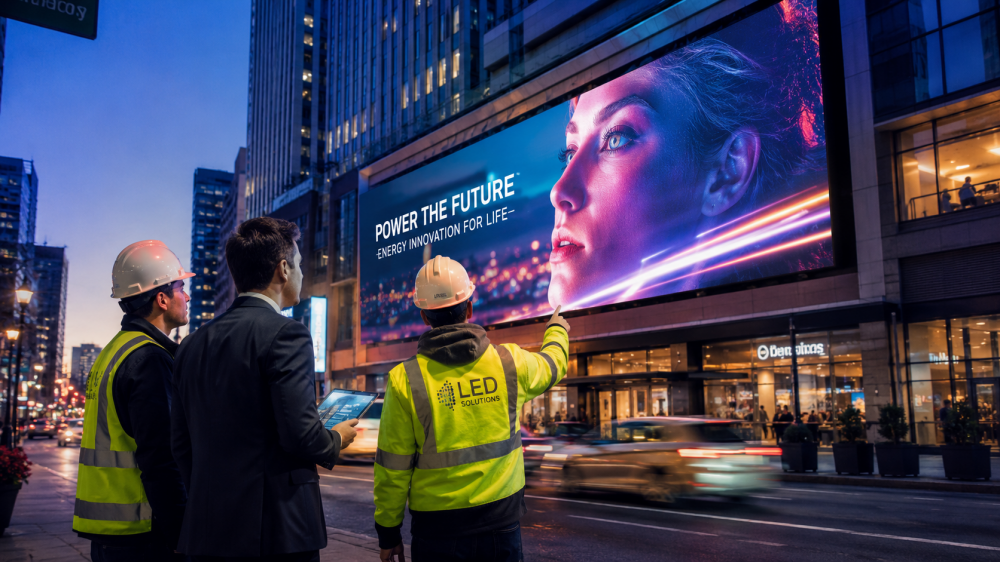
You request quotations from multiple LED display manufacturers in China and receive similar-looking proposals within a few days. The pixel pitch specifications appear comparable. Brightness levels look nearly identical. Pricing differences are substantial, but none of the quotations clearly explain why.
At that stage, the real challenge is no longer comparing specifications. It is identifying which manufacturers genuinely understand the requirements of the US market and which ones are simply exporting hardware without the infrastructure to support long-term installations. A display may look technically suitable on paper, but if the manufacturer lacks certification compliance, spare parts support, warranty processes, or technical assistance for US buyers, the installation can quickly become a maintenance and operational problem.
The reality is that only a limited group of LED display manufacturers in China actively support the US commercial market with the certifications, service systems, and technical capabilities required for professional installations. While China remains the world's largest production hub for LED display technology, manufacturing displays and supporting the US market are two very different capabilities.

This blog explains what separates top LED display manufacturers from general exporters, which certifications US buyers should verify, how to evaluate support infrastructure before procurement, and what the sourcing process should look like when purchasing LED display systems for the US market.
What It Really Means to Serve the US LED Display Market
Many LED display manufacturers in China are willing to ship products to US buyers. However, that does not automatically mean they are equipped to support the US market professionally.
Manufacturers that genuinely serve the US market invest in regulatory compliance, documentation standards, after-sales support systems, and long-term service infrastructure. They understand how commercial LED installations operate in the US and prepare their products accordingly.
This includes:
- Maintaining valid UL and FCC certifications
- Providing English-language technical documentation
- Supporting AV integrators and installation teams
- Offering warranty support with defined response timelines
- Maintaining spare parts availability for long-term projects
- Understanding US electrical and safety requirements
A manufacturer that only focuses on export pricing often lacks these operational systems. The difference usually becomes visible only after installation, when buyers require technical assistance, replacement modules, or warranty support.

For this reason, US buyers should evaluate LED display manufacturers in China based not only on product pricing but also on their ability to support the complete operational lifecycle of the display.
Verify UL and FCC Certifications Before Procurement First!
Regulatory compliance is one of the most important evaluation criteria for US buyers sourcing LED display hardware internationally.
UL Certification for Commercial Installations
Commercial LED displays installed in the US often require UL certification for electrical safety compliance. Top LED display manufacturers serving the US market typically maintain certification under relevant standards such as:
- UL 48 for electric signs
- UL 1433 for changing-message signs
- Additional electrical safety standards depending on application type
Before placing an order, buyers should request the actual UL certification number and verify it through UL's public certification database. The certification must apply specifically to the product being purchased, not just to another product line from the same manufacturer.
FCC Compliance for Electromagnetic Interference
LED displays generate electronic emissions that must comply with FCC Part 15 regulations in the US. This requirement is especially important for installations near communication systems, transportation infrastructure, broadcast facilities, or commercial control environments.
Professional LED display manufacturers in China serving the US market should immediately provide:
- FCC ID documentation
- Compliance reports
- Product-specific certification details
Any hesitation or inability to provide these documents should be treated as a serious concern during procurement evaluation.
How to Evaluate Real US Market Experience
Certifications establish legal compliance, but they do not prove operational capability. Buyers should also evaluate whether the manufacturer has practical experience working with US clients and installations.
Ask for Completed US Project References
Top LED display manufacturers typically maintain portfolios of completed US projects across sectors such as:
- Retail LED installations
- Outdoor advertising displays
- Stadium and arena displays
- Corporate AV systems
- Digital out-of-home (DOOH) networks
Ask for installation references that include:
- Project size
- Installation type
- Integrator or customer references
- Installation photographs
- Operational timelines
Speaking directly with existing US customers often provides more useful insight than any specification sheet.
Review Their US Distribution or Partner Network
Manufacturers genuinely serving the US market usually work with:
- US-based distributors
- AV integration companies
- Technical support partners
- Regional service representatives
A local support network improves communication, logistics coordination, warranty handling, and spare parts supply. Manufacturers operating entirely from China without any US operational presence may struggle to support large commercial projects effectively.
Technical Documentation Matters More Than Most Buyers Realise
One of the clearest indicators of a manufacturer's professionalism is the quality of its technical documentation.
Experienced LED display manufacturers in China that regularly serve US buyers provide:
- Detailed installation manuals
- Controller configuration guides
- Electrical specifications
- Cabinet drawings
- Maintenance procedures
- Content management documentation
Poorly translated documentation often creates installation delays, configuration errors, and support confusion during commissioning.
US AV integrators and contractors rely heavily on technical documentation during installation. Clear and technically accurate manuals indicate that the manufacturer understands international project execution standards.
After-Sales Support Infrastructure
After-sales support determines whether an LED display installation remains operational efficiently across its lifespan.
Many procurement problems do not appear during manufacturing or shipping. They appear years later when components fail and replacement support becomes necessary.
Spare Parts Availability
Professional LED display manufacturers serving the US market maintain spare parts support systems for:
- LED modules
- Receiving cards
- Power supplies
- Control systems
- Signal components
Ask where replacement components are warehoused and what the standard replacement lead times are for US customers.
If all replacement parts must ship from China after a failure occurs, downtime can become operationally expensive.
Technical Support Across Time Zones
Time zone differences between China and the US create practical support challenges.
Top LED display manufacturers serving US buyers usually provide:
- Dedicated English-speaking support teams
- Extended support hours
- US-based service coordination
- Remote troubleshooting support
Manufacturers that only provide support during standard China business hours may create delays during installation or fault resolution.
Final Thoughts
Not every company exporting displays from China is equipped to support the US commercial market professionally. The LED display manufacturers in China that genuinely serve US buyers invest heavily in certification compliance, technical support systems, spare parts infrastructure, and long-term customer relationships.
Before selecting a supplier, verify certifications carefully, review completed US installations, evaluate after-sales capabilities, and assess how the manufacturer handles technical communication and warranty support. These factors matter far more in long-term display performance than pricing differences alone.
The best procurement decisions are made when buyers evaluate both the product and the manufacturer behind it. In large commercial LED display projects, long-term support capability is just as important as display specification itself.





