

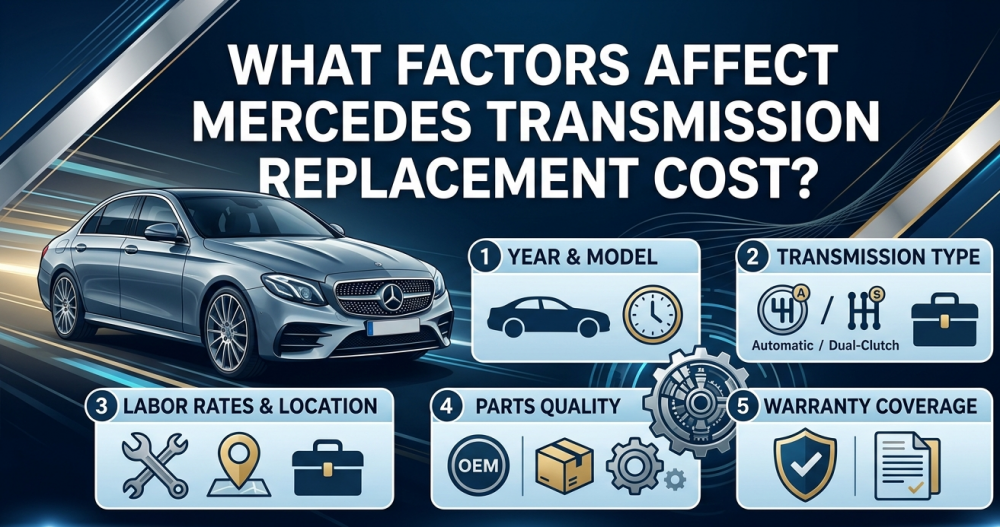
When your Mercedes-Benz develops a transmission problem, the first question most owners ask is: how much is this going to cost me? It's a fair and important question — especially because the answer can vary dramatically depending on several interconnected variables. Mercedes Transmission Replacement Cost is not a fixed number. It's the result of multiple factors working together, and understanding each one gives you the power to make smarter decisions, avoid overpaying, and plan your budget with realistic expectations.
Whether you drive a C-Class, E-Class, GLE, or an AMG performance variant, this breakdown will walk you through the key elements that determine what you'll ultimately pay when your transmission needs to be replaced.
1. The Model and Year of Your Vehicle
Not all Mercedes transmissions are the same, and the specific model you drive plays a significant role in shaping your total repair bill. Entry-level Mercedes models like the C-Class or A-Class tend to have more widely available transmission units than performance-oriented AMG variants or flagship S-Class models, where parts are both more complex and more expensive.

Older models from the late 1990s and early 2000s may actually benefit from lower parts costs due to the abundance of used units in the salvage market. However, some older electronic components that interact with the transmission — such as a deteriorated conductor plate in the 722.6 transmission — can add unexpected costs to the job.
Newer models with advanced 9G-Tronic or AMG SPEEDSHIFT MCT units involve more sophisticated engineering, require specialized software recalibration, and typically push the Mercedes Transmission Replacement Cost into a higher bracket.
2. Type of Transmission Being Installed
One of the biggest cost levers in any transmission replacement job is the type of unit being installed. You generally have three options:
- New OEM Transmission: Sourced directly from Mercedes-Benz or an authorized supplier, a new unit delivers factory-fresh reliability. It is also the most expensive choice — often ranging from $3,500 to $7,000 or more for the part alone.
- Remanufactured Transmission: Rebuilt to OEM specifications using reconditioned and new components, remanufactured units offer a compelling middle ground. They typically come with a warranty and cost significantly less than new units.
- Used Transmission: Sourced from a low-mileage donor vehicle, a quality used transmission can reduce parts costs by 40–60%. When purchased from a reputable supplier with inspection documentation and warranty coverage, this option delivers excellent value — particularly for older Mercedes models.
Your choice here will often be the single largest variable affecting your final bill.
3. Labor Costs and Shop Type
Labor is the second major cost category in any Mercedes Transmission Replacement Cost calculation. Transmission replacement is not a quick job — it typically takes 8 to 15 hours depending on the vehicle model and the accessibility of the transmission in the engine bay.

At an authorized Mercedes-Benz dealership, labor rates typically range from $150 to $250 per hour. Multiply that by 10 hours and you're looking at $1,500 to $2,500 in labor before any parts are considered. Independent European auto specialists often charge $90 to $150 per hour for the same level of work, representing a meaningful savings without sacrificing quality — provided the shop has experience with Mercedes-specific transmissions and the proper diagnostic equipment.
4. Diagnostic and Software Recalibration Fees
Modern Mercedes transmissions are deeply integrated with the vehicle's electronic control systems. When a new or remanufactured unit is installed, it must be paired with the vehicle's ECU and the Transmission Control Unit (TCU) must be recalibrated. This step requires Mercedes-specific diagnostic software — either the factory XENTRY/DAS system or a capable aftermarket equivalent like iCarsoft MB or Autel.
Some shops include this recalibration in their labor estimate; others bill it separately. Always ask upfront whether software recalibration is included, as overlooking this step can cause shifting issues and premature wear on the new unit.
5. Additional Parts Required During Replacement
The transmission unit itself is rarely the only component that gets replaced. When a transmission is removed, it creates an ideal opportunity to address nearby worn components — and in many cases, replacing them simultaneously is more cost-effective than revisiting the job later. Common additional parts include:
- Transmission fluid and filter — Always replaced with a new unit; using fresh fluid is non-negotiable.
- Transmission mounts — Worn mounts are often found during removal and should be replaced to prevent vibration and future damage.
- Torque converter — In many transmission failures, the torque converter is also contaminated or damaged and must be replaced alongside the transmission.
- Gaskets and seals — Standard replacement items that should always be fresh when reassembling.
Each of these adds to the total, and a comprehensive estimate should itemize every component so you know exactly what you're paying for.
6. Geographic Location
Where you live has a direct impact on what shops charge for both parts and labor. In major metropolitan areas — New York, Los Angeles, Chicago — shop rates are significantly higher than in smaller cities or rural areas. Parts availability may also differ by region, with some areas having better access to used Mercedes transmissions through local salvage networks.
If you're willing to ship a used or remanufactured unit from an out-of-state supplier, you may find better pricing than what's available locally. Just factor in shipping costs and ensure the supplier offers a warranty that protects you if the unit arrives damaged or fails shortly after installation.
7. Warranty Coverage
Whether your vehicle is still under factory warranty, a certified pre-owned (CPO) warranty, or a third-party extended warranty can significantly alter your out-of-pocket costs. Mercedes powertrain warranties typically cover transmission replacement during the warranty period, making it essential to use an authorized dealer for covered repairs.
For out-of-warranty vehicles, some third-party mechanical breakdown insurance policies cover transmission replacement — but exclusions, deductibles, and pre-existing condition clauses vary widely. Review your coverage documents carefully before authorizing any work.
Conclusion
The Mercedes Transmission Replacement Cost is shaped by a layered combination of vehicle model, parts type, labor rates, ancillary components, location, and warranty status. By understanding each of these factors, you're better positioned to ask the right questions, evaluate quotes intelligently, and make the choice that best fits your budget and your vehicle's needs. For quality used Mercedes transmission units backed by inspection and warranty support, Moon Auto Parts is a reliable resource trusted by independent shops and individual owners alike — helping you control costs without compromising on the quality your Mercedes deserves.





