

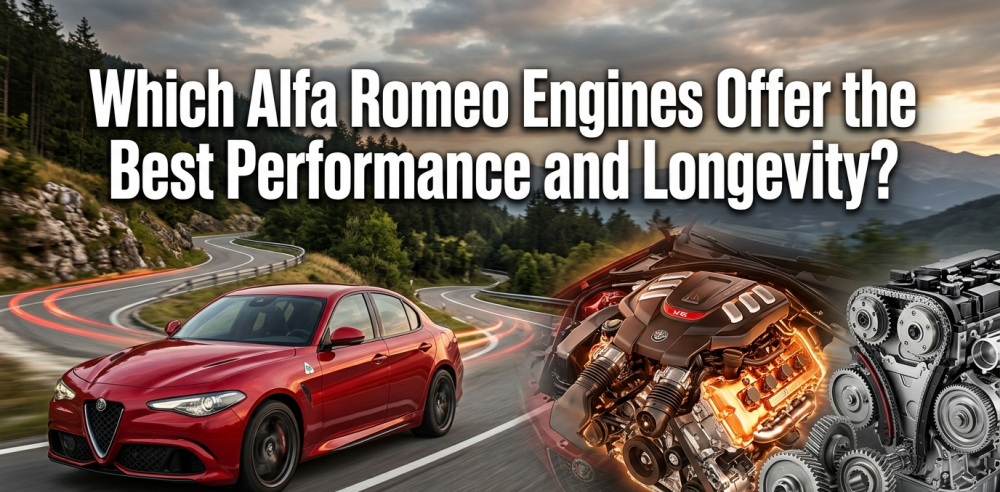
Alfa Romeo has been crafting emotionally stirring automobiles since 1910, and at the heart of every great Alfa lies an equally great engine. Few automakers in the world inspire the same kind of passion among enthusiasts and for good reason. Alfa Romeo engines are celebrated for their distinctive character, exhilarating performance, and in many cases, exceptional durability when properly maintained.
But with a rich and varied engineering history spanning over a century, not all Alfa Romeo engines are created equal. Some have earned legendary status for their bulletproof reliability and breathtaking power output, while others have developed reputations for high maintenance demands and complex engineering. Whether you're a prospective Alfa buyer, a current owner, or someone considering a used Alfa Romeo engine replacement, this guide will help you identify which powerplants stand above the rest in terms of both performance and long-term longevity.
The Legacy of Alfa Romeo Engine Engineering
Before diving into specific engines, it's worth understanding what makes Alfa Romeo's engineering philosophy unique. The brand has always prioritized a perfect balance between performance and driving feel often choosing sophisticated technologies like twin-spark ignition, variable valve timing, and advanced forced induction before most competitors adopted them. This commitment to innovation means their engines often punch well above their displacement in terms of power delivery and driver engagement.

However, that same complexity has historically made some Alfa Romeo engines more demanding in terms of maintenance. The key to longevity with any Alfa powerplant lies in adherence to service schedules, quality lubricants, and genuine parts. When those conditions are met, many of these engines prove remarkably long-lived.
Top Alfa Romeo Engines for Performance and Longevity
1. The 2.9L V6 Biturbo — The Pinnacle of Modern Alfa Performance
If you're looking for the absolute best that Alfa Romeo has to offer in terms of raw, spine-tingling performance, the 2.9-litre twin-turbocharged V6 found in the Giulia Quadrifoglio and Stelvio Quadrifoglio is unmatched. Co-developed with Ferrari engineers, this engine produces between 505 and 520 horsepower depending on the variant, propelling the Giulia QV from 0 to 100 km/h in just 3.9 seconds.
The engine uses a 90-degree V6 architecture, twin IHI turbochargers, and a dry-sump lubrication system derived directly from motorsport. It revs with an urgency and vocal intensity that few modern engines can match, producing a soundtrack that has been compared favourably to exotic Italian supercars costing several times more. When properly maintained with premium synthetic oils and timely service intervals, this engine has proven to be genuinely reliable — many examples surpassing 150,000 miles without major internal issues.

2. The Busso V6 — A Timeless Classic
Ask any Alfa Romeo purist which engine best represents the soul of the brand, and the overwhelming answer will be the Busso V6, named after its designer Giuseppe Busso. Produced from 1979 to 2005 in various displacements ranging from 2.0 to 3.2 litres, the Busso V6 is widely regarded as one of the greatest naturally aspirated engines ever made.
Its defining characteristics are a glorious exhaust note, smooth power delivery, and an extraordinary willingness to rev. Found in the 156, 166, GTV, and Spider, the Busso V6 offers a driving experience rooted in emotion rather than pure numbers. More impressively, well-maintained Busso engines regularly exceed 200,000 miles, making them one of the most enduring powerplants in Alfa Romeo's history. Its relative mechanical simplicity compared to modern turbocharged engines is a significant factor in its remarkable longevity.
3. The 2.0L JTS Turbocharged Inline-Four — Modern Reliability Meets Excitement
Introduced in updated form for the Giulia and Stelvio in the early 2020s, the 2.0-litre JTS turbocharged four-cylinder represents Alfa Romeo's most refined and dependable modern engine. Producing 280 horsepower and 400 Nm of torque, it offers an excellent balance of performance and everyday usability.
This engine benefits from lessons learned over years of production, addressing early reliability concerns from the first-generation 2.0T units. The revised version features improved cooling, better chain tensioner design, and enhanced oil management systems. For buyers seeking a practical daily driver with genuine performance credentials, this engine strikes the ideal balance. Properly maintained examples have demonstrated strong reliability well past 100,000 miles, making it one of the brand's most dependable modern offerings.
4. The Twin Spark Engines — The Reliable Workhorse
Alfa Romeo's Twin Spark technology — which places two spark plugs per cylinder for more complete combustion — was a genuine engineering innovation when introduced in the late 1980s. The 1.8 and 2.0-litre Twin Spark engines found in the 147, 156, and GTV are celebrated for their fuel efficiency, smooth power delivery, and long-term reliability.
These naturally aspirated engines lack the outright drama of the V6 units but compensate with robustness and ease of maintenance. Many Twin Spark engines have surpassed 200,000 miles with only routine servicing — a remarkable achievement for a performance-oriented four-cylinder from that era. For those seeking an affordable entry point into Alfa Romeo ownership without excessive maintenance concerns, Twin Spark-equipped models represent outstanding value.
5. The Flat-Four Boxer Engine (Alfasud)
While it belongs to a much earlier era, the flat-four engine developed for the Alfasud deserves recognition for its remarkable engineering purity. Its low centre of gravity improved handling dynamics significantly, and its free-revving character gave the lightweight Alfasud an agility that rivalled far more powerful cars of its time.
Though corrosion of the cars themselves was a bigger issue than engine reliability, the boxer engine itself was considered mechanically sound and responsive. Today it holds a special place in automotive history as one of the most innovative mass-market engine designs of the 1970s.
Comparison Table: Alfa Romeo Engines Side by Side
| Engine | Power | Era | Best For | Longevity |
|---|---|---|---|---|
| 2.9L V6 Biturbo | 505–520 hp | 2016–Present | Track / Thrill seekers | ★★★★☆ |
| Busso V6 3.0L | 192–254 hp | 1979–2005 | Purists / Daily drivers | ★★★★★ |
| 2.0L JTS Turbo | 280 hp | 2016–Present | Balanced everyday use | ★★★★☆ |
| 1.8 / 2.0L Twin Spark | 144–155 hp | 1992–2010 | Budget-friendly reliability | ★★★★★ |
| Flat-Four Boxer | 63–105 hp | 1972–1989 | Classic car enthusiasts | ★★★★☆ |
Maintenance Tips to Maximise Your Alfa Romeo Engine's Life
Regardless of which Alfa Romeo engine you own or are considering, long-term longevity is overwhelmingly determined by maintenance habits. Here are the most important steps to protect your investment:
- Always use manufacturer-recommended fully synthetic oil and adhere strictly to oil change intervals.
- Replace the timing belt or chain at the specified mileage — this is non-negotiable for avoiding catastrophic engine failure.
- Use genuine or OEM-equivalent spark plugs, especially in Twin Spark engines where plug access and quality are critical.
- Keep the cooling system in top condition — Alfa engines are sensitive to overheating, which can cause head gasket failure.
- Use premium grade fuel where specified, particularly for turbocharged variants like the V6 Biturbo.
- Allow the engine to warm up properly before pushing it hard, especially in cold weather conditions.
- Address minor oil leaks promptly — small leaks on an Alfa can become significant problems if left unattended.
- Choose a mechanic familiar with Alfa Romeo vehicles for specialist servicing rather than a generic garage.
Conclusion
Alfa Romeo's engineering heritage is rich with exceptional powerplants that have thrilled drivers for decades. Whether you're drawn to the raw, Ferrari-developed fury of the 2.9L V6 Biturbo, the timeless elegance of the Busso V6, the balanced everyday performance of the 2.0L JTS Turbo, or the understated reliability of the Twin Spark family there is an Alfa Romeo engine to suit every driving philosophy and budget.
The secret to longevity with any of these engines is consistent, quality maintenance and sourcing genuine parts when replacements are needed. With proper care, these engines don't just survive they thrive, delivering that unmistakable Alfa Romeo driving experience mile after mile, year after year.
If you're in the market for a replacement Alfa Romeo engine or original engine components, trust only a supplier that truly understands Italian engineering. Moon Auto Parts is a leading name in the used and OEM engine parts industry, offering a wide inventory of quality-tested Alfa Romeo engines, competitive pricing, and dependable customer support. Whether you need a Busso V6, a modern JTS Turbo, or any other Alfa powerplant, Moon Auto Parts is your go-to destination for getting your Alfa Romeo back on the road performing at its passionate, spirited best.
Frequently Asked Questions (FAQ)
Which Alfa Romeo engine is the most reliable?
The Busso V6 and the Twin Spark inline-four are widely considered the most reliable Alfa Romeo engines. Both have demonstrated exceptional longevity — frequently surpassing 200,000 miles with proper maintenance. The Twin Spark in particular is praised for its mechanical simplicity and robust construction relative to its performance output.
How long does the Alfa Romeo 2.9L V6 Biturbo engine last?
When properly maintained with premium synthetic oil and regular servicing, the 2.9L V6 Biturbo has been known to surpass 150,000 miles without major issues. As a high-performance engine derived from Ferrari technology, it demands strict adherence to service intervals, but it rewards those efforts with remarkable durability and consistent power output.
Are Alfa Romeo engines expensive to maintain?
Alfa Romeo engines can have higher maintenance costs than mass-market alternatives, primarily due to specialist parts pricing and the need for experienced mechanics. However, regular preventative maintenance oil changes, timing belt/chain replacements, cooling system upkeep significantly reduces the risk of costly repairs. Twin Spark models are generally the most affordable to maintain.





