

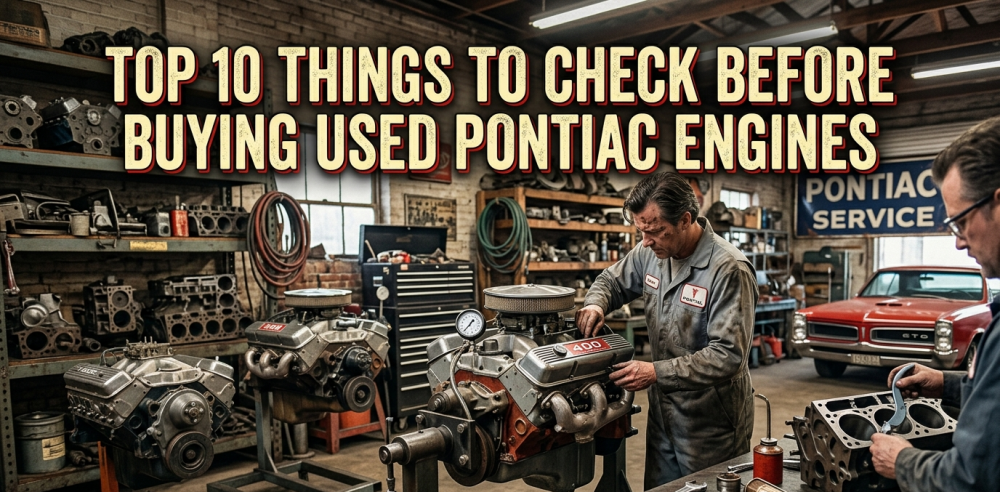
Pontiac may no longer be rolling off production lines, but its legacy lives on in garages, driveways, and racetracks across the country. From the muscle-bound GTO and the iconic Firebird to the everyday reliability of the Grand Prix and Grand Am, Pontiac built vehicles that people genuinely loved and still do. When one of these classics or late-model favourites needs an engine replacement, the aftermarket for Used Pontiac Engines remains surprisingly active and accessible.
But the discontinued nature of the brand cuts both ways. On one hand, there is a large pool of salvaged engines available from decades of production. On the other hand, you cannot walk into a dealership for a factory-fresh replacement, which means due diligence before purchasing a used unit is absolutely essential. A bad engine buy wastes your money, your mechanic's time, and potentially causes further damage to a vehicle you care about.
This guide covers the ten most important things to check before committing to a purchase. Whether you are a seasoned gearhead or a first-time buyer navigating the used parts market, these checkpoints will help you separate a solid investment from a costly mistake.

1. Verify the Engine Code and Compatibility
Before anything else — before you even look at the physical condition of the engine — confirm that the unit you are considering is actually compatible with your vehicle. Pontiac used a wide variety of engines across its production run, from the famous 400 and 455 cubic inch V8s of the muscle car era to the 3800 Series II and III V6s, the Ecotec four-cylinders, and the LS-based V8s in later models.
Engine compatibility goes beyond just the displacement. You need to match the engine code, the generation, the accessory drive layout, and in modern vehicles, the electronic control unit requirements. A small difference in engine code can mean major differences in bolt patterns, sensor locations, and wiring harness compatibility.
Always cross-reference the engine code stamped on the block with your vehicle's VIN decoder before proceeding. Getting this step wrong makes every subsequent inspection irrelevant.
2. Check the Mileage and Source History
Not all miles are equal, and not all used engines come with honest mileage claims. When evaluating Used Pontiac Engines, always ask where the engine came from and request whatever documentation is available.
Engines pulled from insurance write-offs caused by collision damage are among the best candidates — the car may have been totalled by a front-end impact, leaving the engine completely unaffected. Engines from fleet vehicles or well-documented private cars with service records are also strong choices.

Be more cautious with engines from auction lots, salvage yards with no documentation, or sellers who cannot tell you anything meaningful about the donor vehicle. Without a paper trail, you are buying entirely on faith — and that is a significant risk when dealing with a brand that no longer has dealer support.
As a general rule, Used Pontiac Engines with under 80,000 miles and a verifiable maintenance history represent the best value. Over 100,000 miles is not automatically a deal-breaker, but it demands a more thorough inspection and a lower price to compensate for the additional wear.
3. Inspect the External Condition Carefully
A methodical visual inspection of the engine exterior can reveal a great deal before you ever start the engine or run a diagnostic test. Work from top to bottom, looking for the following:
Oil residue and leaks. Dried oil coating around valve covers, rear main seals, the oil pan gasket, and camshaft seals is common on older engines. Light seepage is manageable, but thick, heavy oil deposits around multiple seals suggest the engine has been leaking significantly and may have been running low on oil.
Coolant staining. White or rust-coloured residue around coolant hose connections, the thermostat housing, or the water pump points to past or ongoing cooling system leaks. This is a critical observation on Pontiac's 3800 Series engines, which have a known history of intake manifold gasket failures that cause coolant leaks.
Physical damage. Cracks in the block or head, stripped bolt holes, and damaged timing covers are all serious red flags. Even minor cracks can worsen under operating temperature and pressure.
Corrosion. Surface rust on external components is normal for older engines, but deep corrosion around coolant passages or on machined surfaces should prompt further investigation.
4. Pull the Dipstick — Read the Oil
Few diagnostic steps are as quick or as revealing as removing the oil dipstick and examining what is on it. This single action can tell you whether the engine was maintained responsibly or run into the ground.
Healthy engine oil is amber to dark brown in colour and flows smoothly off the dipstick. Thick, black, sludgy oil is a sign of extended service intervals — meaning the previous owner was not changing the oil regularly. Sludge build-up inside an engine is one of the most damaging long-term conditions possible, clogging oil passages and starving bearings of lubrication.
The most alarming discovery is a milky or creamy substance on the dipstick or oil filler cap. This indicates coolant contamination in the oil — a strong indicator of a blown head gasket or cracked head. This is a non-negotiable deal-breaker. Walk away immediately if you see it.
Also check the oil level. An engine that has been run significantly low on oil has likely experienced bearing and camshaft wear that may not be immediately obvious but will shorten the engine's remaining lifespan considerably.
5. Inspect the Coolant System
Pontiac's 3.8-litre 3800 Series engines — among the most common engines you will encounter when shopping for Used Pontiac Engines — are well known for intake manifold gasket failure. This gasket sits between the intake manifold and the engine block, and when it fails, it allows coolant to leak externally or internally into the oil system.
When inspecting the coolant system, check the following:
- Coolant reservoir and radiator cap: Look for oil droplets floating on the coolant surface or a brown, oily film — signs of combustion gas or oil contamination entering the cooling circuit.
- Coolant colour and clarity: Fresh coolant is typically bright green, orange, or pink depending on the type. Brown, rusty, or murky coolant suggests the cooling system has been neglected and may have internal scale or corrosion build-up.
- Block test: A chemical combustion leak test placed over the coolant filler can detect head gasket failure by identifying combustion gases in the coolant. Any reputable seller should be willing to allow this test on Used Pontiac Engines they are confident in.
6. Perform a Compression Test
A compression test is the most reliable non-invasive method for assessing the internal health of an engine. It measures how effectively each cylinder seals during the compression stroke — reflecting the condition of the piston rings, cylinder walls, and valves.
For most Pontiac V6 and V8 engines, you should expect consistent readings between 150 and 200 PSI per cylinder depending on the engine and compression ratio. What matters most is consistency: all cylinders should read within about 10–15% of each other. A significantly low reading on one or two cylinders suggests localised wear, a failing valve, or a compromised head gasket between those cylinders.
If a seller refuses to allow a compression test, that refusal itself is diagnostic information. Sellers who are confident in their product welcome scrutiny.
7. Check for Timing Chain or Belt Condition
Depending on the engine generation, Pontiac engines use either a timing chain or a timing belt to synchronise the crankshaft and camshaft. Understanding which your prospective engine uses — and what condition it is in — is critical.
Most of Pontiac's V6 and V8 engines use timing chains, which are generally more durable than belts. However, timing chains do stretch over time, particularly when oil changes have been neglected. A worn timing chain produces a characteristic rattling noise at startup and can cause rough running and misfires due to altered valve timing.
Listen carefully for rattling, knocking, or tapping from the timing cover area when the engine is cold-started. If the engine is not running, ask the seller about timing component history and inspect the timing cover for oil contamination that could indicate premature wear.
8. Listen to the Engine Running
If at all possible, hear the engine run before you buy it. Cold starts are especially revealing — many engine problems are most pronounced before the oil has fully circulated and reached operating temperature.
Listen for:
- Knocking or tapping: Deep, rhythmic knocking from the bottom of the engine points to worn rod or main bearings — a major internal repair. Lighter tapping from the top of the engine may indicate valve train issues or low oil pressure.
- Excessive idle roughness: While some older engines have a characteristic lope at idle, significant misfiring or surging suggests ignition, fuel, or compression problems.
- Hissing or whistling: These sounds can indicate vacuum leaks or boost leaks (on turbocharged applications), which affect performance and fuel economy.
- Smoke from exhaust at startup: Blue smoke indicates oil burning. White smoke points to coolant burning — a serious concern. Occasional white vapour on a cold morning is normal condensation and not a concern.
9. Consider the Transmission at the Same Time
If you are replacing the engine in your Pontiac, this is an opportune moment to assess the transmission as well. The labour involved in an engine swap requires significant disassembly of the drivetrain, making it the ideal time to inspect — or even replace — the gearbox if it has high mileage or known issues.
Sourcing a Used Pontiac Transmission from the same donor vehicle as your replacement engine is often the smartest approach. You can be more confident that mileage and service conditions are consistent between the two components, reducing the risk of pairing a fresh engine with a worn-out gearbox that could fail shortly after. Discuss this option with your mechanic before the job begins to avoid unnecessary repeat labour costs.
10. Insist on a Warranty and Clear Terms
The final checkpoint is less about mechanical inspection and more about commercial protection. Any reputable seller of used engines should be willing to offer a warranty — typically between 30 and 90 days — that covers the engine against undisclosed faults.
Get the warranty terms in writing. Understand what it covers, what voids it, and what the process is for making a claim. A warranty does not replace thorough inspection, but it does provide a meaningful safety net if something goes wrong shortly after installation.
Be wary of sellers who refuse any form of warranty, offer only verbal assurances, or use vague language about returns. The used engine market has its share of sellers who prioritise a quick sale over customer satisfaction. Protecting yourself contractually is the final layer of due diligence.
Conclusion
Buying Used Pontiac Engines does not have to be a stressful or uncertain experience. By following these ten checkpoints — from verifying the engine code to running a compression test, inspecting the oil and coolant, listening to the engine run, and insisting on a written warranty — you dramatically increase your chances of finding a solid, reliable unit that delivers real value for money.
Pontiac built engines that were robust, performance-oriented, and built to last. Many of those engines, properly sourced and carefully inspected, still have years of reliable service ahead of them. The key is knowing what to look for and refusing to cut corners in the inspection process.
For buyers who want the confidence of a pre-inspected, warranted engine without the stress of sourcing alone, Moon Auto Parts provides a trusted range of used Pontiac engines that have been assessed for quality and backed by warranty terms you can rely on. When you are ready to get your Pontiac back on the road, Moon Auto Parts is a supplier worth starting with because a great engine sourced well is worth far more than a cheap engine that creates more problems than it solves.
Frequently Asked Questions (FAQ)
Q: What is the most reliable used Pontiac engine to buy?
The 3800 Series III V6 and the LS1/LS2 V8 are considered among the most durable. Avoid early 3800 Series II units without confirmed intake manifold gasket replacement.
Q: How do I find the engine code on a Pontiac engine?
The engine code is stamped on a pad on the front of the block, typically near the cylinder head. Cross-reference it with your vehicle's VIN for compatibility.
Q: Is 100,000 miles too high for a used Pontiac engine?
Not necessarily if it has been well maintained. Inspect thoroughly, check compression, and negotiate the price accordingly.
Q: What is the biggest red flag when buying a used Pontiac engine?
Milky or creamy oil, indicating coolant contamination a sign of head gasket failure. Walk away immediately.
Q: Should I replace the transmission at the same time as the engine?
If the transmission has high mileage or known issues, yes. It saves on repeat labour costs and ensures balanced drivetrain wear.
Read Also: How Do You Inspect Used Subaru Motors Before Buying Them?





