
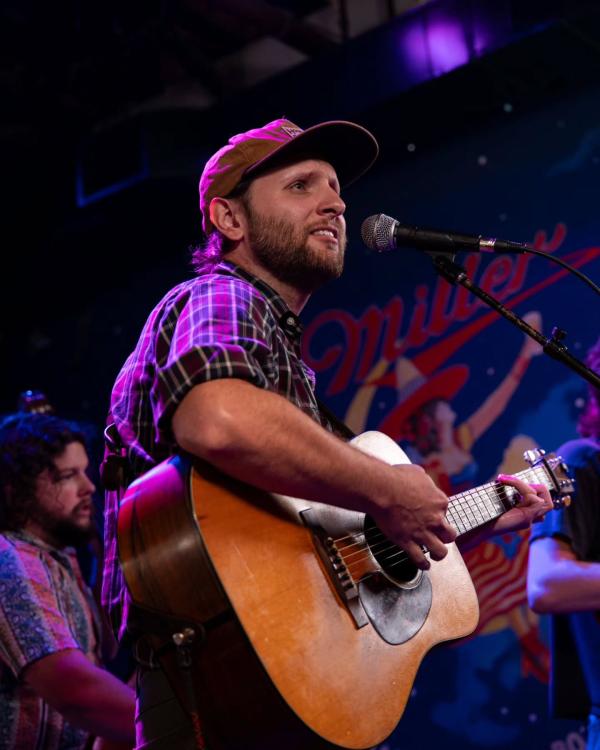
Last year, when I featured Levi Foster and his debut album We Made Fire in my Music Spotlight column, I was drawn to him because he was different. Not only does his music pay tribute to his Appalachian upbringing, Foster also plays to the beat of his own drum and doesn’t worry about trends.
Another person drawn to his uniqueness was Shooter Jennings. Foster’s PR firm reached out to Jennings’ manager, and they sent him the debut album.
Foster stated, “We weren't anticipating anything-- them even responding at all. But no, I called him at a good time, and Shooter listened to it quickly. He called me within like a week or so, and we talked about doing a record together. And I was like, ‘Yeah, I would love to, for sure.’ So, he scheduled me in.”
While Foster had the concept for the record in his mind, he was still writing the music right up to the days of recording. Some songs got swapped for better songs.
People in the music industry know Shooter Jennings also goes to the beat of his own drum (he lives and records in LA, not Nashville), so he was a good match for Foster. “He likes things unconventional,” Foster reported. “We kind of met in the middle.”
The first song from the sophomore album Appalachian Funk Tree that was sent was “Fat Elvis.” Often known for his off-the-wall humor, Foster’s “Fat Elvis” is a rowdy, cinematic introduction to Foster’s evolved sound. (You must follow Levi Foster on Instagram or TikTok. He’s hysterical.) What began as a late-night joke quickly evolved into something larger. “I take a lot of thought into having no pride,” he jested.
Foster is a master songwriter because he enjoys writing narrative songs. He is drawn to them because that’s the music he grew up with.
The title track “Appalachian Funk Tree” is a fine example of Foster’s musical diversity. He explained, “I wanted to make a soundtrack of all the songs and the styles of music that influenced me growing up, basically what got me into doing music in the first place, just paying homage to all those different sounds.
Written during a deer hunt in South Carolina, the idea came to him to build a song that could hold all strains of country music under one roof. The tree became the anchor; a wild thing grew nearby, feeding off bluegrass, funk, Texas swing, rock ’n’ roll… with each verse wandering into a different influence. It is one of the few songs on the record that emphasizes melody over lyric. With country banjo, fiddle, and steel guitar, “Appalachian Funk Tree” will get you moving.
Another song that piqued my interest is “Good Time Ago.” While Foster’s story songs aren't usually autobiographical, this song was written with fellow Virginian Alex Dooley, and it includes elements from both their backgrounds. You literally must listen to the whole song, so you know how everything turns out.
He wrote “Bloodhound” while out in a cabin in the woods, missing his girlfriend, who is now his wife. He compares himself to a dog, laying his heart bare and telling the woman he loves her no matter the distance. He is coming and will find her. It’s the only love song on the record.
The guitar strings bend with “James River Man,” set during the Great Depression, when trouble has a way of finding a man even when he isn’t looking for it. “Blackberry Bramble” is a song about the tale of two brothers and a house of ill repute during the Civil War that is tangled in thorns and legends of lost Confederate gold.
Foster brings back his humor in the song “Slam a Swingin’ Door,” where he says a guy goes to a saloon because his wife can’t slam a swinging door. He wrote it with his friend Carly Zimmerman so that it wouldn’t sound demeaning. It’s a fun song.
Foster channels his inner Marty Robbins as he sings “One Eye Open.” It is a tongue-in-cheek heartbreak song. He doesn’t want his friends to see how bad off he is. That’s why he cries with one eye open.
“Rest Assured” was inspired by the bluegrass gospel songs he sang growing up. It is so good that I think he should do a full gospel album someday. It reminds us that Hope is never out of reach.
The album's most serious song is the final one, “End of Man,” an AI protest song. No career is more threatened by AI than that of a songwriter.
Foster shared, “AI is killing the way people think about things. It’s another convenience that will be an inconvenience down the road. At the end of the day, people need to stay in tune with the earth and our Creator. We are pretty much giving our souls to this machine, and we don’t even know what the outcome of this machine is going to be.”
The chorus succinctly states: Cause It wants to bleed; it wants to feel/ It wants you to believe that it’s really real/ But it’s a train a coming from a far-off land/ And it ain’t stopping till the end of man.
With all the fun and humor that Foster is famous for, he knows when to be serious and what really matters. Appalachian Funk Tree is a culmination of all the things that make Levi Foster who he is. And while the record is personal, having another outside-the-box thinker and musician, Shooter Jennings, produce it makes it even more special.
Working with Jennings left a lasting impression on Foster, an experience he’ll always be thankful for. “Shooter Jennings was generous enough to take a chance on me,” Foster said. “Those two weeks recording in the heart of Hollywood are memories I’ll carry for the rest of my life. I’m deeply grateful to everyone who helped bring these songs to life.”
Levi Foster will tour the East Coast with Colby Acuff, plus some solo dates. Check his tour dates here.
Follow Levi Foster on his website, Facebook, Instagram, TikTok, YouTube, and all streaming platforms.
– – –
Bethany Bowman is a freelance entertainment writer. Follow her blog, Instagram, and X.
Appalachian Funk Tree Track List
- Prologue
- Appalachian Funk Tree
- Fat Elvis
- Yazoo Clay
- Good Time Ago
- Come From the Dirt
- Slam a Swinging Door
- James River Man
- One Eye Open
- Fast Horse
- Blackberry Bramble
- Bloodhound
- Rest Assured
- End of Man