
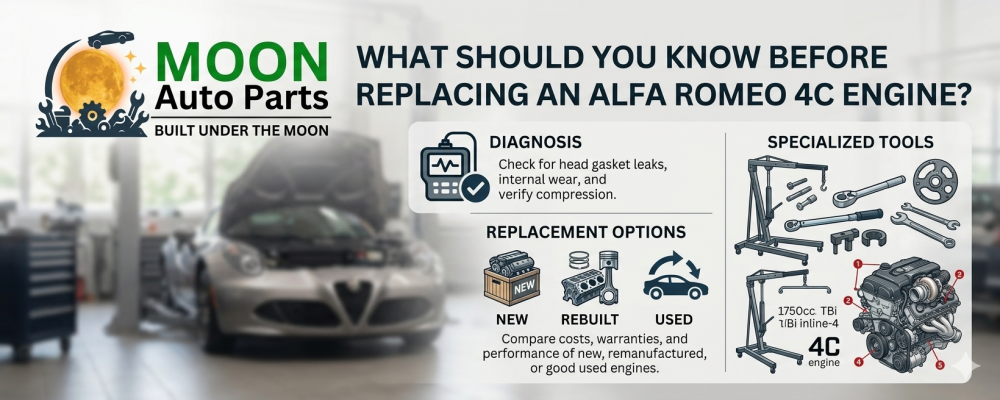
The Alfa Romeo 4C occupies a category almost entirely its own. A 1,900-pound Italian sports car with a mid-mounted turbocharged engine, a carbon fiber monocoque chassis, and driving dynamics that remind you why cars exist in the first place—the 4C is not a vehicle you let go of easily. Which makes a failing Alfa Romeo 4C engine one of the most emotionally charged mechanical problems an enthusiast can face. The good news: the 4C's 1750 Turbo engine is a known quantity. Its architecture is well-documented, its failure modes are understood, and with the right sourcing strategy—replacement engines are available for those willing to navigate the specialty market. This guide covers everything 4C owners need to know about the engine, what tends to go wrong, and how to approach finding a replacement.
The Alfa Romeo 4C Engine & Transmission
The Alfa Romeo 4C (2014–2020) is powered by the 1750 Turbo engine a 1.75-liter, turbocharged, direct-injection inline-four producing approximately 237 horsepower and 258 lb-ft of torque in North American specification. Despite its small displacement, this engine makes extraordinary use of its architecture through an IHI turbocharger, direct injection, and variable valve timing. The engine is mounted mid-rear within the carbon fiber tub, driving the rear wheels through a 6-speed TCT (Twin Clutch Technology) dual-clutch used transmission. The entire drivetrain is optimized for the 4C's extreme weight-to-power ratio, giving the car a 0–60 time in the low-4-second range despite its modest output numbers.
Engine specifications:
- Displacement: 1,742cc (1.75L)
- Configuration: Inline-four, turbocharged, DOHC
- Valve timing: Variable (MultiAir second-generation on some variants)
- Output (North America): 237 hp / 258 lb-ft
- Cooling: Liquid-cooled
- Engine management: Bosch ME 17.3
The same basic engine architecture appears in several other Alfa Romeo and Fiat Group vehicles, though the 4C-specific tune and supporting components differ from passenger car applications.
Why 4C Engines Fail: Known Issues and Failure Modes
The 4C is an enthusiast machine that's often used hard, and its engine—while fundamentally sound—has known vulnerabilities that every owner should understand.
Turbocharger Failures
The IHI turbocharger is a high-performance unit operating under significant heat and pressure. The 4C's tight engine bay makes thermal management more challenging than in a conventional front-engine layout. Turbocharger failures—ranging from bearing wear to oil seal failure—are one of the more common serious issues. A failed turbo can introduce oil into the intake, contaminating the engine and, in severe cases, causing internal damage.
Oil Starvation and Lubrication Issues
The 4C's mid-engine layout and performance orientation mean that proper lubrication is critical and sensitive to maintenance lapses. Owners who push their 4C on track without appropriate oil change intervals—or who use oil that doesn't meet Alfa Romeo's specifications—risk accelerated wear on bearings and camshaft components.
Carbon Buildup (Direct Injection)
Like all direct-injection engines, the 4C's 1750 Turbo is susceptible to carbon buildup on intake valves. Unlike port-injected engines, direct injection doesn't wash the intake valves with fuel, allowing oil vapors from the PCV system to bake onto the valve seats over time. This typically manifests as rough idle, misfires, and reduced power in the 40,000–80,000 mile range.
Cooling System Stress
The compact, high-output engine in a small, tightly packaged car generates considerable heat. The cooling system components—particularly the thermostat and coolant hoses—can deteriorate faster than in a conventional passenger car application. Overheating events, whether from component failure or track use without appropriate preparation, can cause head gasket failure or warped cylinder head damage.
MultiAir System (Where Applicable)
Some 4C variants use Fiat Chrysler's MultiAir hydraulic variable valve actuation system. While sophisticated, the MultiAir system has documented failure modes involving solenoid wear and hydraulic unit degradation. A quality used engine from a high-mileage donor should be evaluated for MultiAir system condition.
The Specialist Challenge: Why 4C Engine Sourcing Is Different
Let's be clear about something: the Alfa Romeo 4C is a low-volume specialty vehicle. Unlike a Toyota Camry or Dodge Charger, the 4C was never produced in enormous numbers—roughly 2,000–3,000 units per year for the North American market. That scarcity affects the used engine market significantly.
You will not find a 4C engine at a typical pull-a-part salvage yard. The parts that do become available come from totaled or heavily damaged 4Cs, and those vehicles are rarer than mainstream cars by definition. This means:
- Inventory is limited. At any given time, fewer used 4C engines are available than virtually any mainstream car engine.
- Prices reflect scarcity. Expect to pay more per unit than you would for an equivalent displacement engine from a higher-volume vehicle.
- Sourcing from knowledgeable suppliers matters more. A supplier that understands the 4C's specific architecture and failure modes is worth significantly more than a generic used parts warehouse.
What to Ask Before Buying a Used Alfa Romeo 4C Engine
Given the specialty nature of this engine, your due diligence needs to be thorough:
1. What caused the donor vehicle to be retired? An engine from a collision-totaled 4C is very different from one pulled due to structural rust or a separate mechanical failure. Understand the history.
2. Was the engine running at the time of removal? Ideally, you want confirmation that the engine was operational when pulled.
3. What is the documented mileage? With a low-volume vehicle, donor cars may span anywhere from 10,000 to 80,000+ miles. The range matters.
4. Has the turbocharger been inspected? Ask specifically about the turbo—bearing play, shaft seal condition, and evidence of oil contamination in the intake.
5. What warranty is offered? A supplier willing to back a 4C engine with meaningful warranty coverage is demonstrating genuine confidence in the part.
6. Is VIN-based compatibility confirmed? While the 4C engine is consistent across model years, confirm the specific build year and specification of the engine relative to your vehicle.
Installation Considerations: This Is Not a DIY Project
The Alfa Romeo 4C's engine replacement is a complex, specialist job. The carbon fiber monocoque requires specific handling procedures. The mid-engine layout means the drivetrain must be properly removed and reinstalled with attention to the rear cradle, differential connections, and chassis integration points. This work should only be performed by an experienced independent shop with documented Alfa Romeo or Italian sports car experience. Before selecting an installer:
- Ask specifically about their 4C or Alfa Romeo experience
- Request references from previous 4C owners if possible
- Confirm they have access to Alfa Romeo-specific service documentation
- Discuss a complete inspection of the cooling system, turbo connections, and supporting components during the install
The Broader Value Proposition: Why Save a 4C?
The Alfa Romeo 4C is irreplaceable in a very literal sense. Production ended in 2020, and Alfa Romeo has not announced a direct successor. Finding a 4C in comparable condition to your existing vehicle—especially one with known history and documented maintenance—is genuinely difficult. For 4C owners, a quality engine replacement is almost always the correct financial and emotional decision. You're not just keeping a car running; you're preserving one of the last analog, lightweight, mid-engine sports cars accessible to non-millionaire enthusiasts.
Moon Auto Parts and the 4C: Our Commitment to Specialty Vehicles
At Moon Auto Parts, we serve the full spectrum of vehicle owners—from everyday commuters to specialty car enthusiasts who need a supplier that understands their vehicle. When we source Alfa Romeo 4C engines, we bring the same documented inspection process, mileage verification, and warranty commitment that we apply to every engine in our inventory. Our 4-year / 40,000-mile warranty on eligible engines, VIN-based compatibility confirmation, and knowledgeable support team mean that 4C owners get the careful, expert treatment their vehicles deserve. We also offer financing options to qualified buyers and free shipping to commercial addresses in the USA.
Conclusion
Replacing the engine in an Alfa Romeo 4C is not the simplest or cheapest repair in the automotive world. But for owners of this exceptional machine, it's often the most rewarding one. A properly sourced, professionally installed used engine restores everything that makes the 4C special—the explosive mid-range torque, the howling exhaust note, the immediate steering response that only a lightweight, rear-drive car delivers. Contact Moon Auto Parts today to discuss Alfa Romeo 4C engine availability. Our specialist team will work with you to find the right unit and make your 4C whole again.
Read more - How Much Does a Dodge Avenger Engine Replacement Cost?