
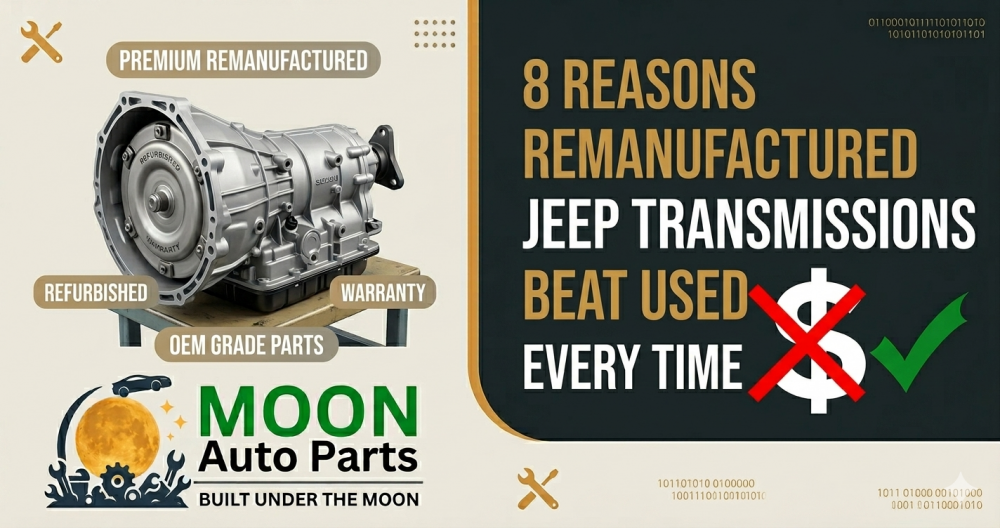
When your Jeep's transmission gives out, you face a choice that can significantly impact your wallet and your off-road adventures for years to come. Should you buy a used transmission pulled from a salvage yard, or invest in a remanufactured Jeep transmission rebuilt to factory specifications? Here are eight compelling reasons why remanufactured wins the comparison almost every time.
1. Every Internal Component Is Inspected and Replaced
A remanufactured Jeep transmission does not simply get cleaned and resealed. Every internal component — clutch packs, steels, seals, solenoids, bearings, and bushings — is inspected and worn or damaged parts are replaced with new OEM-spec components. A used transmission, by contrast, comes as-is. Whatever internal wear exists stays inside until it causes a problem after installation.
2. Updated Parts Correct Known Factory Defects
One of the most significant advantages of remanufactured Jeep transmissions is the use of updated components that address documented factory weaknesses. Jeep's 45RFE, 545RFE, 65RFE, and NAG1 transmissions all have known failure points that remanufacturers specifically address with improved parts during the rebuild process. You receive a transmission that is often more reliable than the original factory unit.
3. Longer and More Comprehensive Warranty Coverage
Reputable remanufactured Jeep transmission suppliers typically offer warranties arranging 4 years 40k miles warranty coverage. Used transmissions from salvage yards with limited warranties at best, and some offer no warranty at all. The longer warranty window on a remanufactured unit provides genuine peace of mind, especially for Jeep owners who use their vehicles for off-road applications.
4. Consistent, Documented Quality Standards
Remanufacturing facilities follow strict quality control protocols that mirror OEM manufacturing standards. Every rebuilt Jeep transmission is tested on a dyno or test stand before shipping to verify proper operation across all gear ranges. This documentation gives you verifiable proof of quality before installation something a used transmission from a salvage yard simply cannot provide.
5. Immediate Compatibility Confirmation
Remanufactured Jeep transmissions are rebuilt and catalogued by specific Jeep model, year, engine, and drivetrain configuration. When you order a remanufactured unit for your Wrangler JK, Cherokee XJ, Grand Cherokee WJ, or Gladiator JT, compatibility is confirmed before the order ships. Used transmissions require manual verification that is often based on incomplete or inaccurate donor vehicle information.
6. Lower Long-Term Cost of Ownership
While a remanufactured Jeep transmission costs more upfront than a used salvage unit, the total cost of ownership over years is frequently lower. The cost of reinstalling a failed used transmission additional labor, downtime, and possibly a second parts purchase can easily exceed the initial savings. A quality remanufactured unit reduces the probability of early failure significantly.
7. Better Performance for Off-Road Applications
Jeep owners who wheel their vehicles off-road place extraordinary demands on transmissions. A freshly remanufactured transmission with new friction materials, updated valve body components, and fresh seals handles heat, stress, and load cycling far better than a used unit with unknown wear history. For serious Jeep enthusiasts, this performance advantage is not theoretical — it is the difference between a trail finish and a trail recovery.
8. Core Return Programs Reduce Your Net Cost
Most remanufactured Jeep transmission suppliers operate core return programs, meaning you send back your failed original transmission in exchange for a credit typically $200 to $600 applied against your purchase. This rebate system brings the effective cost of a remanufactured unit much closer to used pricing while still delivering all the reliability advantages of a fully rebuilt transmission.
Frequently Asked Questions (FAQ)
How much do remanufactured Jeep transmissions cost?
Remanufactured Jeep transmissions typically range from $1,500 to $3,500 depending on the model and configuration, before installation labor costs. Core return credits can reduce the effective price by $200 to $600.
Which Jeep transmissions are most commonly remanufactured?
The 45RFE, 545RFE, 65RFE, 68RFE, 42RLE, and NAG1 (722.6) are among the most frequently remanufactured Jeep transmissions due to their widespread use across Wrangler, Cherokee, and Grand Cherokee models.
How long does a remanufactured Jeep transmission last?
With proper maintenance and fluid changes, a quality remanufactured Jeep transmission can last 100,000 to 150,000 miles or more, comparable to a new OEM unit.
Does a remanufactured transmission affect my Jeep's resale value?
A properly documented remanufactured transmission installation can actually support resale value by demonstrating that a major mechanical issue was addressed with a quality solution rather than a patch repair.
Do I need to re-flash my Jeep's TCM after installing a remanufactured transmission?
In most cases, no. However, for newer Jeep models with electronically adaptive transmissions, a TCM reset or reflash may be recommended after installation. Confirm this with your mechanic before the swap.
Read more - How to Buy Used Suzuki Transmission Without the Stress?