
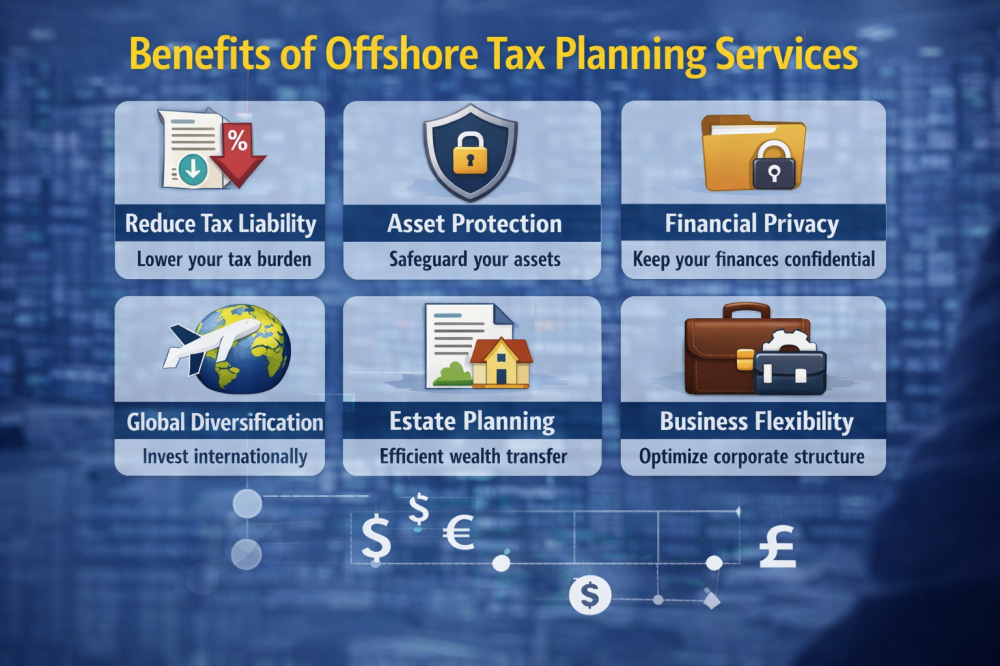
Offshore tax planning services involve the strategic structuring of a business's operations, investments, and financial activities across multiple international jurisdictions — with the goal of legally minimizing tax exposure while maintaining full regulatory compliance.
This is not a niche strategy reserved for large multinationals. Today, mid-size companies, holding entities, digital businesses, and cross-border investors all rely on structured offshore tax planning to remain financially competitive in a globalized economy.
Core services under this umbrella typically include:
- International tax structuring — designing entity structures across jurisdictions to optimize tax treatment
- Cross-border compliance planning — ensuring obligations are met across all countries of operation
- Corporate tax optimization — legally reducing effective tax rates through treaty utilization and income allocation
- Profit repatriation strategies — managing how and when profits flow back to parent entities
- Transfer pricing compliance — documenting and pricing intercompany transactions correctly
- Risk and regulatory management — identifying and mitigating tax-related legal risks globally
The core principle: Offshore tax planning is about tax efficiency through global strategy — not tax evasion or avoidance in the legally prohibited sense.
Why Are Businesses Investing in Offshore Tax Planning Services?
The global business environment has become significantly more complex. Companies now generate revenue across borders — often without physical offices in every country they operate in. Digital services, remote work models, and global supply chains mean that tax obligations don't follow simple geographic lines anymore.
Without proactive planning, businesses commonly face:
- Double taxation — paying tax on the same income in two or more jurisdictions
- Missed treaty benefits — failing to claim reduced withholding tax rates available under bilateral tax treaties
- Regulatory penalties — non-compliance with OECD BEPS (Base Erosion and Profit Shifting) frameworks
- Inefficient cash flow — tax payments draining working capital that could otherwise fund growth
- Reputational risk — operational structures that appear aggressive under increasing public and regulatory scrutiny
Offshore tax planning services address all of these challenges proactively rather than reactively.
7 Key Benefits of Offshore Tax Planning Services for Global Businesses
- Reduced Overall Tax Liability Through Jurisdiction Optimization
The most direct benefit is a reduction in global effective tax rate. Tax advisors analyze:
- Where corporate entities are legally registered
- Which bilateral tax treaties apply between operating countries
- How revenue is allocated across jurisdictions
- Whether transfer pricing rules are being applied optimally
By aligning operational activities with favorable but fully compliant tax frameworks, businesses legally reduce unnecessary tax burdens. This isn't about exploiting loopholes — it's about structuring operations correctly from the start.
Example: A technology company earning royalty income may benefit significantly from routing intellectual property ownership through a jurisdiction with favorable IP tax regimes and strong treaty networks, rather than holding it in a high-tax headquarters country.
- Improved Cash Flow Through Strategic Tax Timing
High tax exposure doesn't just reduce profits — it directly restricts working capital and the ability to reinvest in the business. Offshore tax planning improves cash flow by:
- Legally deferring tax payments to align with business cash cycles
- Optimizing dividend distribution timing and structure
- Reducing withholding taxes on cross-border payments through treaty planning
- Managing cross-border transactions to minimize tax leakage
Businesses that optimize their tax cash flow gain a compounding advantage: more capital available earlier means more capacity for innovation, hiring, market expansion, and R&D — all of which generate further revenue.
- Full ComplianceWithEvolving Global Tax Regulations
One of the most common misconceptions about offshore tax planning is that it operates in a gray area of compliance. In reality, modern offshore tax planning services are built around compliance — not despite it.
Tax advisors ensure adherence to:
- OECD BEPS Action Plans — preventing base erosion and profit shifting
- Transfer pricing documentation — meeting country-by-country reporting requirements
- Economic substance regulations — ensuring entities have genuine operational presence where they claim residency
- CRS and FATCA — automatic exchange of financial account information between tax authorities
- Local filing and disclosure obligations — across every jurisdiction of operation
Proactive compliance is significantly less expensive than reactive remediation after a tax authority audit or investigation. Offshore tax planning services reduce the risk of penalties, reputational damage, and costly restructuring.
- Structured Support for International Market Entry and Expansion
Every time a business enters a new market, it faces a new set of tax obligations, compliance requirements, and structural decisions. These decisions made early — during entity formation — have compounding effects on future tax efficiency.
Offshore tax advisors help businesses:
- Select the optimal legal entity type and jurisdiction for a new market
- Structure subsidiary relationships to avoid unnecessary tax leakage
- Manage cross-border revenue flows between parent and subsidiary entities
- Ensure local compliance from day one, avoiding retroactive penalties
- Align expansion strategy with available tax incentives and investment treaties
A poorly structured international expansion can cost a business far more in ongoing tax burden than the upfront cost of proper planning. The best time to engage offshore tax planning services is before entering a new market, not after problems emerge.
- Protection and Optimization of Business Assets and IP
Offshore tax planning is not limited to income tax. It also encompasses how businesses own, protect, and monetize their assets — particularly intellectual property.
Strategic asset structuring benefits include:
- IP holding structures — locating intellectual property ownership in jurisdictions with favorable IP tax regimes (patent boxes, R&D incentives)
- Holding company optimization — using holding company structures to efficiently receive dividends, capital gains, and royalties
- Investment protection — using jurisdictions with strong bilateral investment treaties to protect foreign investments from political risk
- Centralized treasury management — consolidating group financing through tax-efficient treasury centers
These strategies allow businesses to retain a greater share of earnings within compliant, optimized structures — rather than losing value to unnecessary taxation at each tier of the corporate group.
- Strategic Decision-Making Supported by Expert Tax Intelligence
Modern offshore tax planning goes well beyond annual compliance. Leading advisory firms provide forward-looking intelligence that directly informs C-suite and board-level decision-making.
This includes:
- Tax impact modeling — forecasting the tax consequences of proposed transactions, acquisitions, or restructurings before they occur
- Scenario planning — comparing the tax outcomes of different structure options to support strategic choices
- Global risk assessment — identifying regulatory changes in key markets before they create compliance gaps
- Profitability analysis by region — understanding true after-tax profitability across international operations
Businesses that integrate tax strategy into corporate planning — rather than treating it as a year-end obligation — consistently achieve better financial outcomes and fewer costly surprises.
- Significant Long-Term Cost Efficiency
Many businesses address tax challenges reactively: they expand internationally, encounter problems, and then pay to restructure inefficient arrangements. This approach is consistently more expensive than proactive planning.
The costs of reactive tax management include:
- Professional fees for emergency restructuring
- Back taxes, interest, and penalties from non-compliance
- Reputational damage from public tax disputes
- Lost treaty benefits that cannot be claimed retroactively
- Management time diverted from core business activities
Proactive offshore tax planning services eliminate most of these costs by building efficient, compliant structures from the outset. The investment in upfront planning typically delivers multiples in ongoing tax savings and avoided remediation costs.
Who Needs Offshore Tax Planning Services?
Offshore tax planning is relevant for a broader range of businesses than many assume. Key candidates include:
- Multinational corporations operating in three or more countries with complex intercompany transactions
- Mid-market businesses expanding internationally for the first time
- Digital and SaaS companies generating revenue in multiple countries without physical presence
- Private equity and investment funds with cross-border portfolio investments
- Family offices and high-net-worth individuals with international investment portfolios
- E-commerce businesses selling across borders and facing multi-jurisdiction VAT and income tax obligations
- Companies with significant intellectual property seeking to optimize IP ownership and royalty flows
If your business generates income from more than one country, offshore tax planning services are likely to deliver measurable financial benefit.
Common Misconceptions About Offshore Tax Planning
"Offshore tax planning is illegal."
It is not. Offshore tax planning operates entirely within the law. It uses legally available structures, bilateral tax treaties, and established jurisdictional rules to minimize tax exposure. The distinction between legal tax planning and illegal tax evasion is clear: planning uses lawful structures and transparent reporting; evasion conceals income or misrepresents facts to tax authorities.
"Only large companies benefit."
Mid-market and growing businesses often benefit disproportionately from offshore tax planning because the savings relative to planning costs are significant, and early-stage structural decisions shape long-term tax efficiency.
"Offshore structures are automatically suspicious."
Tax authorities focus on substance and compliance — not geography. A properly structured offshore entity with genuine economic substance and full transparency to tax authorities is entirely appropriate.
What to Look for in an Offshore Tax Planning Service Provider
When evaluating providers, prioritize firms that demonstrate:
- Multi-jurisdictional expertise across your key markets
- Compliance-first orientation — not aggressive planning that creates risk
- Transparent fee structures with clear deliverables
- Integration capability — ability to coordinate with your existing tax, legal, and finance teams
- Track record in your industry and business model
- Current knowledge of OECD BEPS developments and local regulatory changes
Avoid firms that promise unusually large tax reductions with minimal documentation or substance requirements — these structures typically fail under scrutiny and create far greater costs down the line.
Frequently Asked Questions About Offshore Tax Planning Services
Q: Is offshore tax planning the same as tax evasion? No. Tax evasion is illegal concealment of income. Offshore tax planning uses lawful structures, treaty benefits, and jurisdictional rules transparently and in full compliance with reporting requirements.
Q: How much can a business save through offshore tax planning? Savings vary significantly depending on business model, jurisdictions involved, and current structure. For businesses with significant international operations, effective tax rate reductions of 5–15 percentage points are achievable through compliant planning.
Q: Does offshore tax planning require relocating the business? Not necessarily. Many strategies involve creating specific entities or structures offshore while the core business operations remain in the home country.
Q: How do OECD BEPS rules affect offshore tax planning? BEPS rules have made aggressive offshore structures significantly harder to sustain. However, they have not eliminated legitimate offshore tax planning — they have shifted the focus toward structures with genuine economic substance and full transparency.
Q: When should a business engage offshore tax planning services? Ideally, before international expansion begins. The earlier structural decisions are made correctly, the greater the long-term efficiency. However, existing structures can also be reviewed and optimized.
Final Thoughts: Are Offshore Tax Planning Services Worth the Investment?
For any business with meaningful international operations, the answer is almost always yes.
The compounding benefit of a correctly structured global tax position — lower effective tax rates, improved cash flow, full compliance, and strategic flexibility — significantly outweighs the cost of professional advisory services.
More importantly, the cost of not planning — inefficient structures, missed treaty benefits, compliance failures, and reactive restructuring — consistently exceeds what proactive planning would have cost.
Offshore tax planning services transform taxation from a cost center into a strategic financial advantage. For businesses operating across borders, that advantage compounds year after year.